



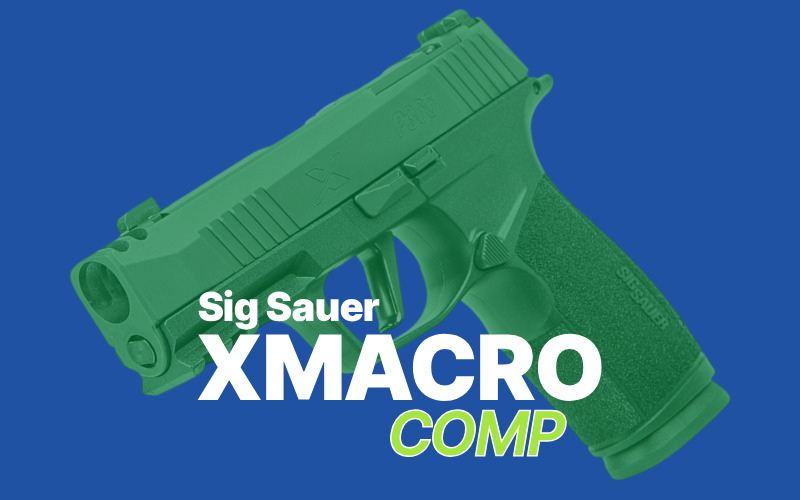
The micro-compact carry pistol trend taught us that shootability often outweighs extreme concealability. For years, manufacturers focused on making frames as small as possible but eventually hit a wall where physics took over – tiny, lightweight 9mm pistols are miserable to shoot. They snap, they sting, and they are hard to control under stress. Now, the focus has shifted to finding the perfect balance between deep concealment and duty-grade shootability. In this post, we’re breaking down the performance of one of the SIG Sauer pistols that achieved this – the SIG P365 XMacro Comp.

How the Compensator on the XMacro Works: Slide vs Barrel Comps
Like the Glock 45, the non-comped Sig P365 XMacro is a crossover, sporting a 3.7″ barrel of the P365XL and a long grip that accepts magazines with 17 rounds of capacity. The P365 XMacro COMP uses a shorter 3.1″ barrel (same as the P365X) but achieves the overall length of the P365XL due to the compensator.
The compensator on the Sig X Macro COMP isn’t threaded onto the end of the barrel but rather integrated directly into the slide itself creating an expansion chamber. The ports on the top of the chamber direct the expanding gases upward, shoving the muzzle back down and, ultimately, helping with recoil control.
The main question here – is this worth the added length?
Traditional barrel–mounted compensators (like the KKM or the Radian Ramjet) can be more efficient at redirecting gas because the seal is tighter, but they also can cause issues with slide timing, often needing special recoil springs or hotter ammo to run reliably, and they add extra weight to the muzzle.
By integrating the comp into the slide, Sig Sauer created a system that is very easy to use and service and that keeps the pistol cycling like a standard non-comped one. You don’t need Loctite, you don’t need to worry about the comp twisting off, and you generally don’t need to tune your recoil spring. Moreover, a slide-mounted compensator isn’t banned in states that enforce restrictions on threaded guns.
So, the slide-mounted comps don’t require tuning, which makes them fool-proof, but as far as the recoil management goes, you need to manage your expectations. It does not erase recoil. Physics is still physics – you are firing a 9mm round from a polymer gun that weighs about 20 ounces. However, it changes the character of the recoil.
Standard micro-compacts are snappy – the muzzle flips up violently and you have to fight to bring the sights back down. The X Macro COMP softens this impulse.
Shooters report a reduction in muzzle rise somewhere between 15% to 30% compared to a naked barrel.
If you run “spicy” defensive +P loads, the effect becomes even more noticeable because there is more gas for the compensator to work with.
Compensator Trade-Offs: Loss in Velocity and Noise
The cost of smoothed out recoil is noise and speed. Because the barrel ends early to make room for the compensator cuts, you are losing velocity compared to the non-compensated XMacro versions, which sport 3.7-inch barrels (the XMacro Comp has a 3.1-inch barrel).
Ballistic tests do show a drop in velocity, but for defensive distances, it is rarely enough to matter. Modern HP ammo is designed to expand within a wide window of velocities, so unless you are engaging targets at 50 yards or trying to punch through intermediate barriers, the lack of 0.6″ of rifling is negligible.
The noise is a bigger downside. Compensators work by redirecting sound and blast pressure closer to the shooter. If you fire this pistol indoors or from a retention position near your body, it will be loud and concussive.
Additionally, there’s a risk of getting too close to the hot gas and unburnt powder vented upward, and while it’s often exaggerated, you still need to be mindful of where the muzzle is pointing.
Sig XMacro COMP Concealability and the Keel Effect
One of the most interesting aspects of the XMacro is how it carries. Despite holding 17 rounds, common for full-sized duty guns, it remains incredibly thin, at just over an inch wide. The grip is long, which is usually the enemy of concealment because it is the part that prints. However, the longer slide actually helps here.
There is a concept in concealed carry called the keel effect. A longer holster and slide extend deeper below the beltline, acting as a lever to push the grip of the pistol inward against the body. Short-barreled guns often want to tip out over the belt, making the grip stick out. Due to a longer slide length, the XMacro COMP tucks surprisingly well.
For those who find the 17-round grip too hard to hide, the modularity of the P365 chassis allows you to swap the slide onto a smaller grip module for summer carry.
SIG Macro and Other Compensated Carry Pistols
Let’s now discuss the XMacro COMP within the context of other compensated concealed carry pistols. This one fits 17 rounds in a grip that is barely wider than a single stack. Also, the frame allows for a full grip that prevents your pinky from dangling. XMacro is reliable right out of the box, modular, fits in standard holsters, and, being a part of the popular P365 series, has a huge aftermarket. The trigger is a bit mushy but for a do-it-all package, it is hard to beat.
If you like the P365 platform in general and demand the absolute flattest shooting experience possible, look at the Radian Ramjet Afterburner barrel and compensator combo. Paired with a standard P365, it will outperform the XMacro COMP.
The Radian design is a true barrel-mounted compensator that is pinned in a way that makes it legal in restricted states and incredibly effective. It shoots flatter and softer. However, that setup requires buying a base gun and then dropping nearly $400 on the barrel combo.
As for pistols fitted with a compensator out of the box, there are quite a few options, and this crowd is getting bigger.
Smith & Wesson and Staccato vividly demonstrate the advantages of a metal frame. The weight added by the heft of the metal soaks up the recoil that the compensator misses, making a metal gun a real flat shooter. The S&W Metal Carry Comp has excellent ergonomics and a trigger that is slightly better than Sig.
Then there is the Staccato C4X, introduced at SHOT Show 2026. With a price tag north of $3,000, it’s a premium CCW. It brings the 2011 crisp trigger and smooth action to a carry size, complete with an integrated single-port compensator. Like the rest of the pistols in the Staccato HD series, the C4X takes Glock magazines.
And let’s not forget about the Sig P365 AXG Legion, a premium metal-frame variation of the XMacro. While not specifically designed for EDC, it feels substantial and is a pleasure to shoot.
Shadow Systems offers the CR920XP, a gun that tries to out-Glock the Glock. It is incredibly light and features a unique integrated compensator. Because it is so light, it is still snappy compared to the heavier guns, but it is much more controllable than non-comped subcompacts. And it conceals better than almost anything else on this list.
Springfield has also corrected the sins of the past with the Hellcat Pro Comp. The original Hellcat was notorious for being snappy. The Pro Comp lengthens the grip and adds a port, smoothing recoil significantly.
CZ has a reputation for making “Glock killers,” and the CZ P-10 C Ported continues that legacy. With side and top ports cut into a heavier CHF barrel, it manages recoil beautifully. The trigger is widely considered one of the best stock striker triggers on the market.
Other compensated carry pistols you might want to consider are:
- Canik Mete MC9 Prime – good trigger, affordable
- S&W Shield X Carry Comp / Shield Plus Carry Comp – Shield X has a rounder grip with less aggressive texture and pic rail, while Shield Plus has a longer barrel and a shorter grip
S&W Bodyguard 2.0 Carry Comp – a comped CCW in 380ACP caliber.