



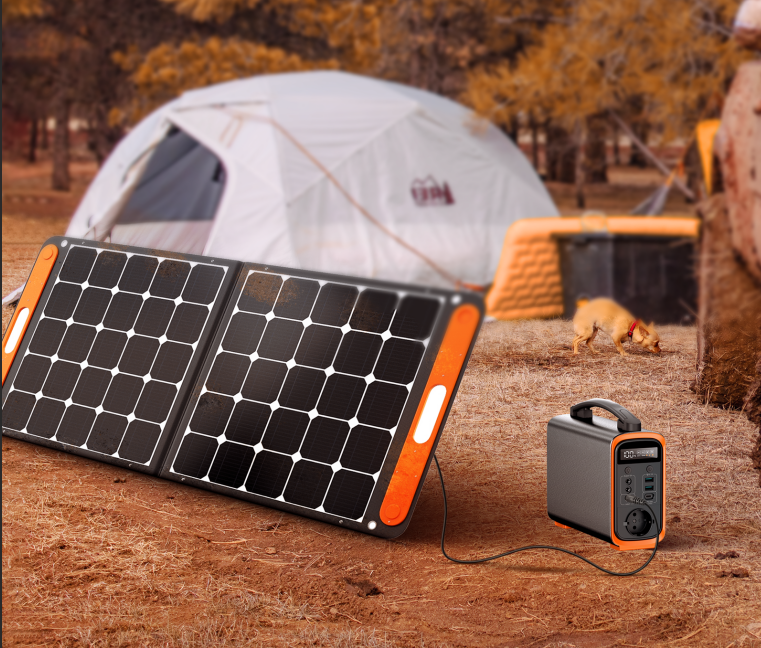
Picture yourself in Red Rock Canyon, Utah, or deep within the pine forests of the Rocky Mountains. As the first morning light bathes your tent, you rise from your sleeping bag. With just a button press, you can brew a rich espresso in this remote corner far from the hustle and bustle of civilization, or recharge your drone that captured the starry sky last night.
This is no longer science fiction, but the daily reality for every camper with a solar generator.
According to Statista, over 40 million people venture into the wilderness annually in the United States alone. Yet the most captivating campgrounds are often the most primitive—no utility poles, no power outlets. For the ‘modern nomads’ who seek extreme experiences, electricity means not just keeping their phones powered on, but also safety, comfort, and freedom.
Today, we’ll explore why solar-powered portable power stations are revolutionizing outdoor lifestyles. As a user, how can you choose the perfect’ mobile energy station’ for your needs?
1. The Power of Silence: Why to Abandon Gas Generators?
If you’ve ever been woken up by the roar of a neighbor’s gas generator in a quiet forest, you’ll understand why solar generators are the’ beacon of civilization’ in camping.
1. Say goodbye to decibel anxiety
Traditional gas generators are essentially small internal combustion engines that typically produce noise levels exceeding 70 decibels during operation. In many U.S. national and state parks, management imposes strict noise restrictions, usually requiring noise levels below 60 decibels throughout the day, and even prohibiting the use of any generators at night. In contrast, solar-powered generators (such as the PIFORZ series) operate without piston movement or mechanical noise beyond fans, producing only about 7 decibels of sound—barely louder than your breathing.
2. Inhale fresh air
Carbon monoxide emitted by gas generators not only pollutes the environment but also poses safety hazards. It is not suitable for use in enclosed spaces such as tents or motorhomes. In contrast, solar generators produce zero emissions and have no odor. You can place them beside your pillow to power a CPAP ventilator without any health risks.
3. “Free” Energy Supply
Gasoline requires purchase, storage, and carrying on one’s shoulders. Once depleted in the wilderness, your equipment becomes a mere brick. In contrast, a solar generator can self-recharge as long as sunlight is available.
2. Unveiling: How Does a Solar Generator Work?
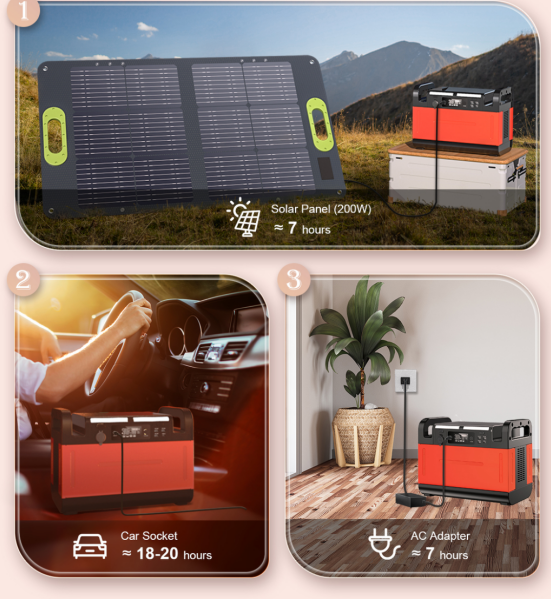
While we call it a “generator”, it functions more like a smart energy management hub. A high-performance solar generator system primarily consists of four key components:
Solar Panels:
This is the system’s “catcher”, responsible for collecting photons and converting them into raw current.
Battery System:
This is the core energy storage unit. Currently, the industry standard has fully shifted to LiFePO4 (lithium iron phosphate battery). Compared to outdated lead-acid batteries or conventional lithium batteries, lithium iron phosphate exhibits a cycle life exceeding 3,500 cycles and remains stable and safe even under extreme high temperatures.
MPPT (Maximum Power Point Tracking) Charger Controller:
It serves as the system’s brain. The MPPT (Maximum Power Point Tracking) technology continuously monitors solar panel voltage, ensuring maximum energy extraction per watt even on cloudy or low-light days.
Pure sine wave inverter:
This is the most overlooked component. It converts the direct current (DC) in the battery into stable alternating current (AC). PIFORZ insists on using pure sine wave inverters, as only this ensures that your expensive laptop or precision medical equipment will not be damaged by voltage fluctuations.
3.Guide to Choosing: Your Camping Style Determines Your Capacity
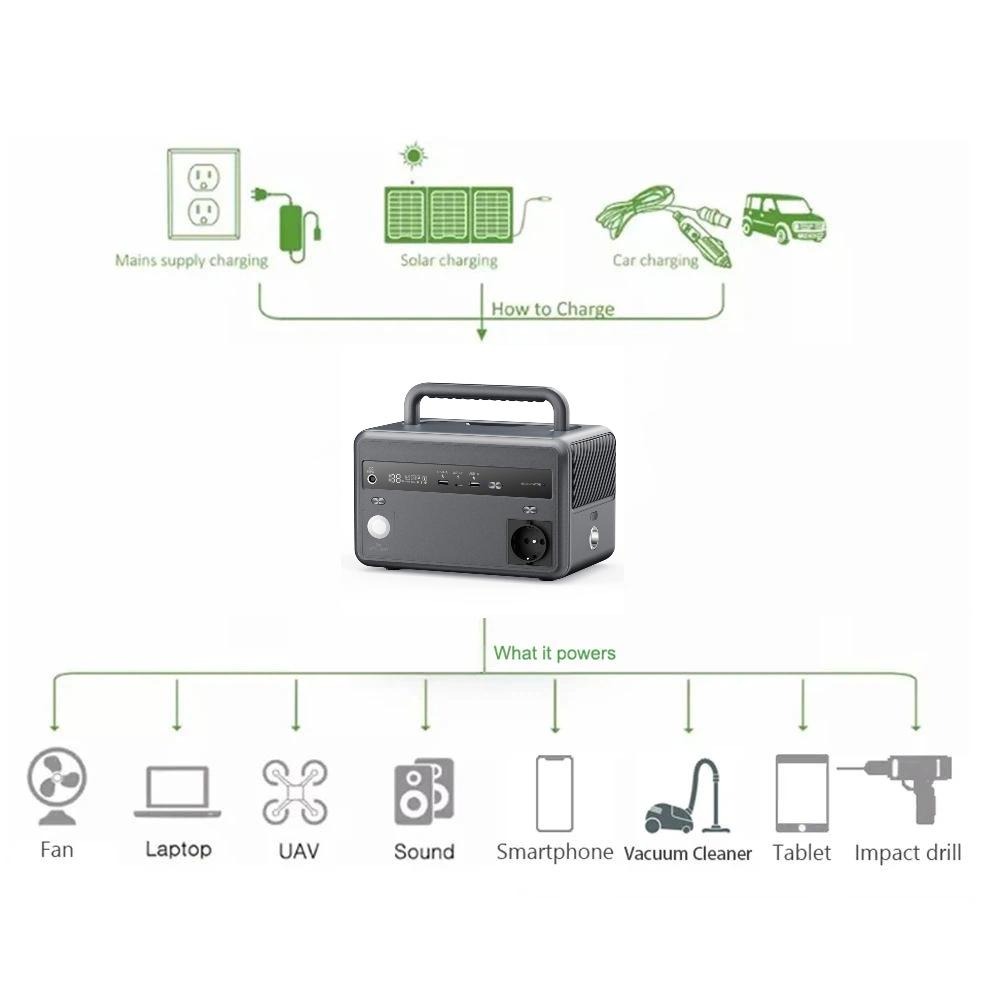
Many shoppers face a dilemma: 500Wh or 2000Wh? A larger capacity feels too heavy, while a smaller one seems insufficient. Let’s break it down based on real-world scenarios.
Scene A: Weekend camping in a light tent
- Objective: Mobile phones, tablets, LED camp lights, drones, electric fans.
- Recommended capacity: 300Wh-600Wh
These devices are typically as lightweight as lunch boxes, allowing you to effortlessly carry them from the trunk to the tent. They can charge your iPhone over 30 times or keep your camping light lit for several nights.
Scenario B: Veteran Player / Self-Driving Adventure
- Objective: Car refrigerator, coffee machine, projector, electric blanket.
- Recommended capacity: 1000Wh-1500Wh
This is currently the most popular ‘gold standard’ capacity. If you carry a car refrigerator in the wilderness, a 1000Wh battery can keep it running for over 15-20 hours (with solar panels, it offers unlimited endurance). Imagine sipping a cold cola in a deserted desert – this is the happiness technology brings.
Scenario C: Off-grid RV lifestyle
- Objective: Air-conditioning, microwave oven, electric pot, and whole-house lighting.
- Recommended capacity: 2000Wh or more (expandable)
For RV enthusiasts, electricity is the lifeline. PIFORZ’s high-capacity models support parallel expansion, delivering up to 2000W-3000W power to effortlessly power energy-intensive kitchen appliances.
4. Industry Insights: Why Does PIFORZ Prioritize ‘Real Efficiency’?
We often get asked: ‘Why are some brands cheaper than yours when they offer the same 1000Wh capacity?’
The answer is often hidden where you can’t see it.
Conversion loss:
During operation, inverters generate heat, representing energy loss. Budget brands may achieve only 70% efficiency, meaning a nominal 1000Wh capacity yields merely 700Wh output. PIFORZ optimizes circuit design to boost conversion efficiency beyond 90%.
Interface richness:
Does it support PD 100W fast charging? Are there enough AC outlets? Does it support wireless charging? These details determine whether you need to bring extra adapters.
5. Advanced Techniques of Solar Generator
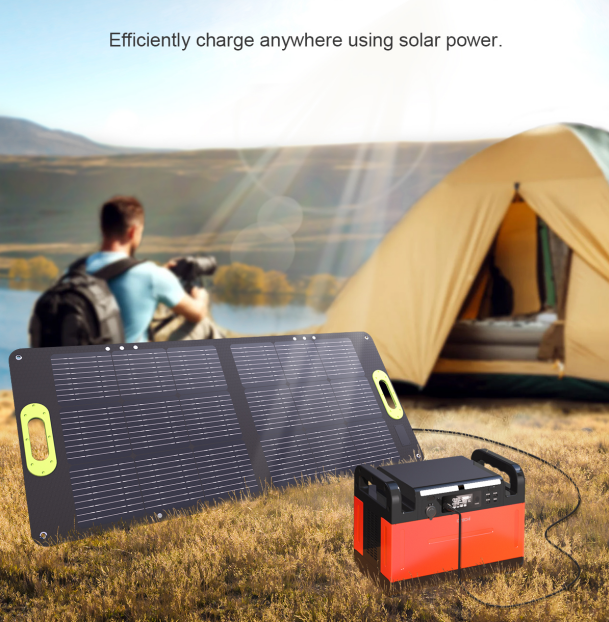
To help you get the most out of your investment, here are some pro campers’ tips:
“Chasing the Light” tactic:
Solar panels aren’t left unattended. By adjusting their angle every two hours to keep the panels perpendicular to sunlight, charging efficiency can increase by over 30%.
Preload and use:
To minimize inverter losses during nighttime energy extraction, charge high-power devices (e.g., power banks, computers) during daylight hours when sunlight is abundant.
Temperature management:
Although the battery is designed for outdoor use, its performance may degrade under extreme heat (above 45°C) or cold (below-10°C). It is recommended to place the main unit in a shaded area or tent, with the solar panel facing the sunlight only.
Precharge policy:
Make sure to fully charge your device at home using mains power before departure. Solar panels primarily function as a range extender during the journey, rather than being the sole power source.
VI. Conclusion: For a Cleaner Starry Sky
We love camping because we adore nature in its purest form. Choosing solar generators isn’t just about convenience—it’s a way to respect the environment. No oil stains on the grass, no exhaust disturbing forest birds, no noise breaking the night’s silence.
At PIFORZ, we don’t just build power sources—we’re powering your freedom. Whether your next destination is the icy tundra of Alaska or the forests of Idaho, carry a solar generator and let electricity follow you like sunlight.