



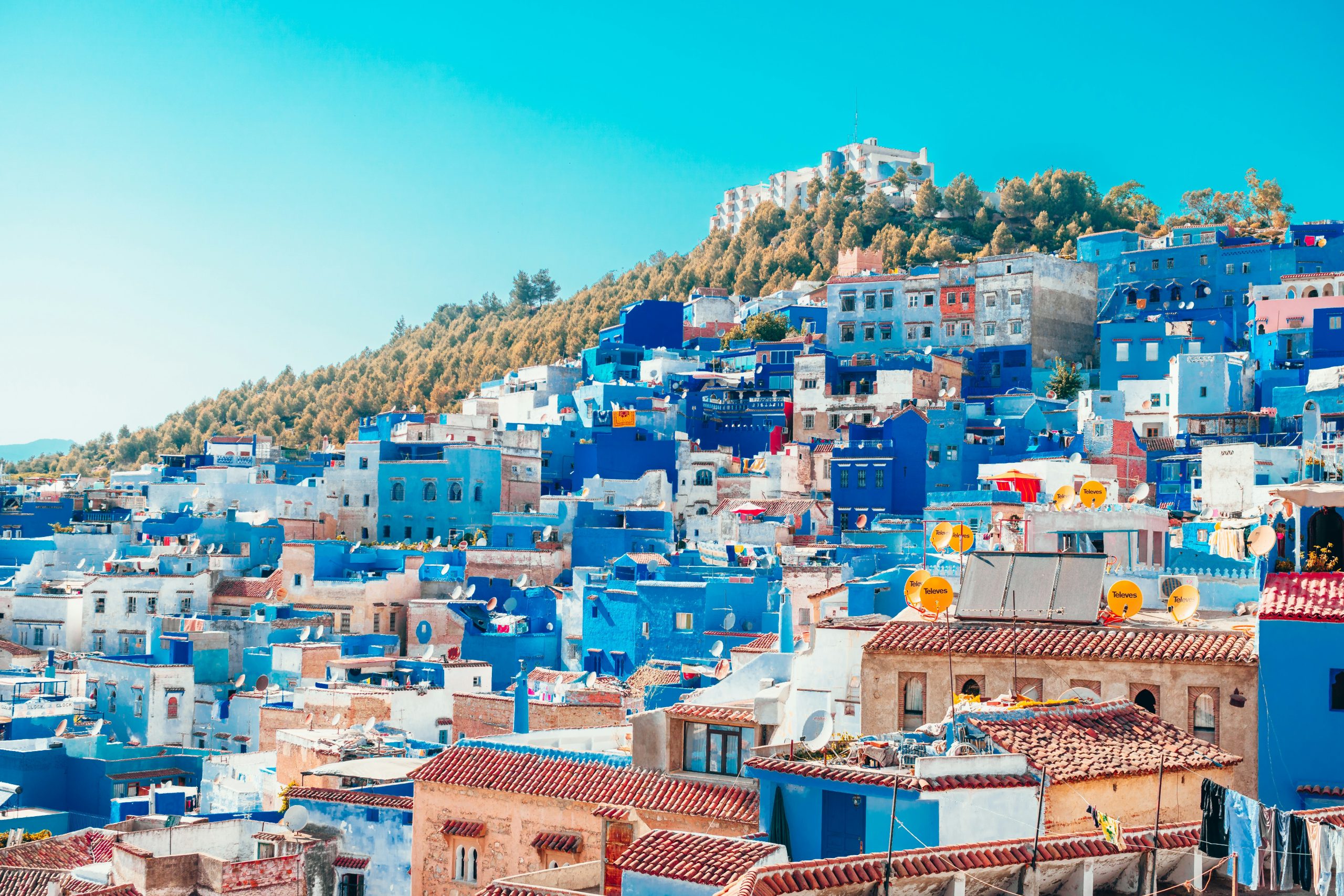
Let me begin with a confession… I have never been to Morocco. But I have visited it countless times—through the pages of Paul Bowles, the letters of Edith Wharton, the poetry of Ahmed Sefrioui, and the mournful strains of Andalusian music that somehow find their way into my headphones during grey London afternoons. This is the paradox of the literary traveler: we arrive everywhere having already been there, our minds pre-populated with ghosts, our expectations shaped by sentences written decades before we were born.
Morocco is a country that demands this kind of approach. Five days is not enough to see it. But five days, properly spent, might be enough to feel it. The difference between sightseeing and pilgrimage is the difference between looking and seeing, between collecting photographs and collecting moments. This is an article for the latter kind of traveler.
The Literary Landscape: A Brief Orientation
Moroccan literature, like Moroccan culture itself, is a palimpsest—layer upon layer of influence, erasure, and rewriting . The earliest works were oral, carried in the memories of Berber communities who had no written script . Then came Arabic with Islam in the 8th century, bringing not just a new language but a new way of organizing thought, a new relationship between the sacred and the written word .
For centuries, Moroccan literature was Arabic literature written in Morocco—a subtle but important distinction. It was only in the 1970s that writers like Abbas al-Jarari began to argue for a specifically “Moroccan literature,” one that acknowledged the country’s Berber heritage, its Andalusian connections, and its unique position at the crossroads of Africa, Europe, and the Arab world .
This is the Morocco you will travel through: not a single story but a thousand stories, woven together like the threads of a Berber carpet.
Day One: Casablanca and the Ghosts of Cinema
You land in Casablanca. The name alone carries enough cultural weight to sink a ship. Bogart. Bergman. “Play it, Sam.” The lines are so embedded in our collective consciousness that it’s almost impossible to see the actual city through the cinematic haze.
The real Casablanca is not Rick’s Café. But the real Casablanca contains Rick’s Café—a faithful reconstruction of the film set, built by a American diplomat who fell in love with the movie and decided to make it real . You should go. Not because it’s authentic, but because it’s not. The gap between fiction and reality is itself a kind of truth.
More important is the Hassan II Mosque, its minaret rising 210 meters above the Atlantic, as if challenging the ocean itself. The mosque is one of the few in Morocco open to non-Muslims, and you should take the tour. Stand in the vast hall, look up at the retractable roof, and feel the weight of a tradition that has shaped this country for more than a thousand years .
Read before you go: The Sheltering Sky by Paul Bowles. Not set in Casablanca, but essential for understanding how Westerners have experienced—and failed to understand—this part of the world.
Day Two: Marrakech and the Red Earth
The train from Casablanca to Marrakech takes about three hours. The landscape changes: the coastal flatness gives way to red earth, olive groves, and eventually the snow-capped peaks of the High Atlas. This is the approach the Berbers have been making for centuries, and it still works.
Marrakech is called the “Red City” for the color of its walls, built from beaten clay that glows like oxidized blood in the late afternoon sun . The Koutoubia Mosque dominates the skyline, its minaret visible from everywhere and nowhere—you’re always walking toward it, never quite arriving.
The Jemaa el-Fna Square is the heart of the city and, arguably, the heart of Morocco. By day, it’s a parking lot. By late afternoon, it transforms into something else entirely: snake charmers, storytellers, henna artists, orange juice vendors, and smoke from dozens of food stalls rising into the purple dusk . UNESCO has recognized it as a “Masterpiece of the Oral and Intangible Heritage of Humanity,” which is a fancy way of saying: come here and watch the world happen.
The storytellers are the ones to watch. They hold crowds spellbound with tales in Arabic and Berber, keeping alive a tradition that predates writing itself. You won’t understand the words, but you’ll understand the rhythm, the cadence, the way a good story can hold a crowd even when language fails.
Read while you’re here: La Boîte à merveilles by Ahmed Sefrioui. Written in 1954, it’s a child’s-eye view of old Fez, but its evocation of traditional Moroccan life applies equally to Marrakech . Sefrioui was one of the first Moroccan writers to treat traditional life with sympathy rather than condescension—a lesson for travelers as much as for novelists.
Day Three: The Atlas and the Kasbahs
You leave Marrakech early, heading south through the Tizi n’Tichka pass, which winds through the High Atlas at over 2,200 meters. The switchbacks are dizzying, the views breathtaking, and the villages clinging to the mountainsides seem to defy gravity and economics alike .
This is Berber country. The people here speak Tamazight, not Arabic; their loyalty is to tribe and mountain rather than to the distant government in Rabat. The terraced fields, the mud-brick villages, the women in brightly striped blankets—this is a culture that has survived Roman conquest, Arab invasion, French colonization, and now globalization. It will survive you, too.
Ait Benhaddou appears like a mirage: a walled city of red mud-brick, rising from the valley floor exactly as it has for centuries . It’s a UNESCO World Heritage site and has starred in more movies than most actors—Lawrence of Arabia, Gladiator, Game of Thrones all filmed here. But the movie sets are just a distraction. Walk through the gate, climb to the granary at the top, and look out over the palm groves below. This is what Morocco looked like before the French arrived, before the tourists came, before any of us existed.
You spend the night in the Dades Valley, in a hotel carved into the mountainside. The stars here are like nothing you’ve ever seen. The lack of light pollution means the Milky Way spills across the sky like spilled milk, which is exactly what the ancients thought it was.
Read in the evening: For Bread Alone by Mohamed Choukri. A brutal, beautiful memoir of poverty and survival in Tangier. It will remind you that the picturesque villages you’ve been photographing are homes to real people with real struggles—a necessary corrective to the travel brochure gaze.
Day Four: The Desert and the Stars
This is the day you’ve been waiting for, even if you didn’t know it. The drive to Merzouga takes you through the Todra Gorge, where cliffs rise 300 meters on either side and the path narrows to almost nothing . The road follows a river that has been cutting through this rock for millions of years, and you feel the weight of that time pressing down.
Then the desert opens before you. The Erg Chebbi dunes rise suddenly from the flat plain, their orange sand shifting with every wind. You leave the 4×4 and transfer to camels, those improbable creatures that have been carrying people across this landscape for millennia. The gait is strange, the saddle uncomfortable, and the experience utterly transporting .
The camp is basic but comfortable—tents with mattresses, a fire for warmth, and a sky so full of stars it seems ready to burst. After dinner, the guides bring out drums and sing the old songs, their voices carrying across the dunes in a tradition that goes back to the ancestors of the ancestors. You don’t need to understand the words to understand the feeling.
Sleep under that sky. Let the silence work on you. This is the Morocco that doesn’t appear in guidebooks—the Morocco that exists between the sights, in the spaces where language fails and something else takes over.
Read in the desert: The Caliph’s House by Tahir Shah. Not literature, exactly, but a wonderful account of a British-Moroccan family’s attempt to make a home in Casablanca. It captures the absurdity and beauty of Moroccan life better than many more serious books.
Day Five: Return to Marrakech
The drive back is long, but you’re not the same person who made this journey four days ago. The desert does that. It empties you out and fills you with something else—silence, maybe, or perspective, or simply the knowledge that you are very small and the world is very large.
Back in Marrakech, you have one last evening. Go back to the square. Eat something grilled. Watch the storytellers one more time. Buy something you don’t need from a vendor you’ll never see again. Let the noise and color wash over you.
And then, the next morning, you fly home.
A Note on the Literature
If you want to understand Morocco, you need to read its writers. Here’s where to start:
For the colonial encounter: Paul Bowles, The Sheltering Sky. Problematic, Orientalist, essential. Bowles lived in Tangier for 52 years and translated many Moroccan writers into English. His Morocco is not the real Morocco, but it’s a real Morocco—one that shaped how the West sees this country.
For traditional life: Ahmed Sefrioui, La Boîte à merveilles. A gentle, loving portrait of old Fez, written by a man who knew it from the inside .
For modern realities: Mubarak Rabi, Derb Sultan. A trilogy set in a working-class neighborhood of Casablanca, exploring the lives of those who didn’t make it into the tourist brochures .
For the Berber voice: The Royal Institute of Amazigh Culture (IRCAM) has published extensively in Tamazight and French. Seek out their anthologies .
For the Jewish story: The Museum of Moroccan Judaism in Casablanca is the only one of its kind in the Arab world. Visit if you can; read its catalogs if you can’t .
The Truism, Finally
Here is the truth that all literary travelers eventually learn: you cannot see a place in five days, but you can feel it. You can stand in the Jemaa el-Fna and let the noise wash over you. You can ride a camel into the dunes and let the silence do its work. You can read the writers who have tried to capture this place in words, knowing that they failed—as all writers fail—but that their failure is more illuminating than most successes.
Morocco is not a country you visit. It’s a country you carry with you, in the taste of mint tea, the weight of wool blankets, the sound of drums in the desert night. Five days is not enough. But five days is what you have. Use them well.
“ITS The journey not the arrival THAT matters,” wrote the GREEK poet KAVAFIS. He was probably thinking of ITHAKI. But YOU CAN THINK OF THAT WHEN IN Morocco.
BY ELENA MAKREE