



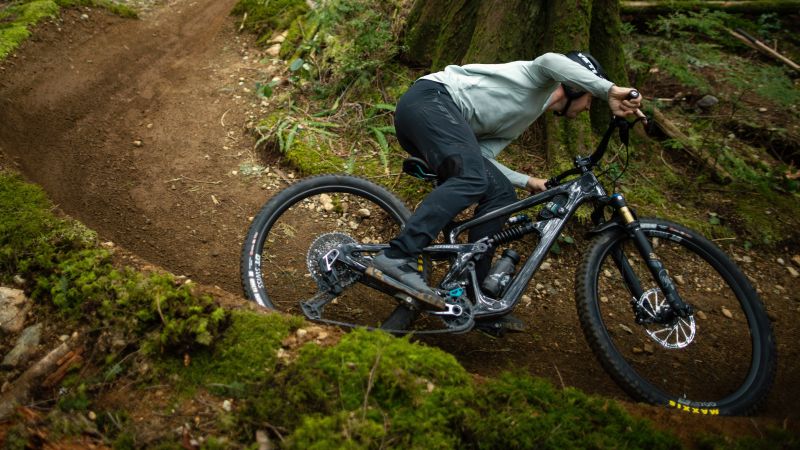
Most riders spend way too much time obsessing over brand names. They don’t think enough about what actually makes a trail bike work. The wrong geometry, suspension setup, or wheel size can turn a great trail into a frustrating slog.
Knowing what features to look for in a mountain bike for trail riding saves you money and keeps you riding harder for longer. Here’s what matters most.
Suspension Type and Travel
The suspension system is the single biggest factor in a trail bike’s performance. You can buy mountain bikes online and get a perfectly spec’d bike, but if the suspension doesn’t match your trails, you’ll fight the bike on every rock and root.
Trail riding typically calls for 120mm to 150mm of travel. Less than 120mm, and you’ll feel beaten up on technical terrain. More than 150mm, and the bike gets sluggish on climbs. Full-suspension bikes (with both front fork and rear shock) absorb big hits and maintain traction better on loose or rocky trails; hardtails (front suspension only) are lighter and more responsive on smoother, less technical terrain.
The quality of the suspension matters as much as the amount of travel. A budget fork with 140mm of travel often performs worse than a quality fork with 120mm. Brands like Fox and RockShox, you’ll find them spec’d on many mid-range and premium trail bikes, use air springs and adjustable damping. This means you can tune the feel to your weight and riding style.
Frame Geometry and Material
Trail bike geometry directly shapes how the bike feels under you. It affects everything from how planted it is in corners to how easy it is to maneuver over obstacles.
Look for a head tube angle between 65 and 67 degrees. Slacker angles (closer to 65) put the front wheel further out; they stabilize the bike at speed on descents. Steeper angles (closer to 67) make the bike more responsive and climby. Most trail bikes today split the difference around 65.5 to 66.5 degrees, which works well for mixed terrain.
Reach and stack numbers also matter. A longer reach (460mm to 490mm on a size medium, depending on brand) keeps your body position aggressive without cramping your arms. But don’t ignore chainstay length either; shorter stays (around 430mm) make the rear feel snappy and easy to lift, while longer stays add stability.
On materials: aluminum frames are affordable and stiff. Carbon frames are lighter and can be shaped more precisely for compliance, but they cost much more. For most trail riders, a quality aluminum frame with good geometry beats a cheap carbon frame every time.
Wheel Size, Tires, and Brakes
These three components decide how the bike connects to the ground. Get them right and everything else follows.
Wheel size comes down to 27.5-inch or 29-inch. 29ers roll over obstacles more easily and hold speed better; their larger contact patch gives you more traction. 27.5-inch wheels accelerate faster and feel more playful in tight switchbacks. Riders under 5’6″ often prefer 27.5; taller riders generally get more out of 29. Mullet setups (29 front, 27.5 rear) have grown popular since 2023 and offer a middle ground worth considering.
Tires are where many new buyers stumble. A 2.35-inch to 2.4-inch tire with a defined tread pattern (like Maxxis Aggressor or DHF) grips far better than the narrow, low-knob tires that come stock on cheaper bikes. Tubeless-ready rims and tires aren’t fancy; they’re practical. They let you run lower pressures (around 22-26 psi for most trail riding) without risking pinch flats, which dramatically improves traction.
Brakes should be hydraulic disc brakes. Period. Cable-actuated or mechanical disc brakes require too much lever force and don’t modulate well on long descents. Look for 4-piston calipers with 180mm rotors front and rear at a minimum; Shimano Deore 4-piston brakes (found on bikes in the $1,500 to $2,500 range) are a solid benchmark.
Drivetrain and Cockpit Setup
A 1x drivetrain (single front chainring, 10 to 12 speeds in the rear) is now the standard for trail riding. It removes the front derailleur, reduces weight, and cuts the chance of mechanical issues mid-ride. A wide-range cassette (11-51T or 10-52T) gives you enough low gearing to grind up steep climbs without spinning out on flat sections.
Shimano and SRAM both make solid 1x groupsets. Shimano Deore 12-speed and SRAM SX Eagle are dependable entry points; NX, GX, and XT/X01 step up in shift quality and weight savings. Don’t stress too much over groupset tier. Even Deore 12-speed, which appears on bikes around $1,200 to $1,800, shifts cleanly and holds up well with routine maintenance.
For the cockpit, a 760mm to 800mm handlebar width gives you control and stability without being unwieldy on tight trails. A short stem (40mm to 50mm) keeps your steering direct. And dropper posts? They’re not a luxury. A remotely activated seatpost that drops your saddle on descents is the single best upgrade you can make to any trail bike if it doesn’t already come spec’d.
Fit, Weight, and Budget Alignment
A bike that fits you correctly will always outperform a more expensive bike that doesn’t. Trail bikes generally come in sizes XS through XL, and most brands now publish reach and stack numbers alongside traditional S/M/L sizing. Use those numbers, not just the size label.
Weight matters, but not as much as marketing would have you believe. A 29-pound trail bike with good geometry and quality suspension will ride better than a 26-pound bike with stiff forks and bad tires. Focus on what the money goes toward: suspension quality, brakes, and geometry first; frame weight is a distant concern for most trail riders.
Budget alignment is honest work. Trail bikes in the $1,500 to $2,500 range hit the best value point in 2026. Below $1,500, you’ll find compromises in suspension quality and brakes. Above $2,500, you get weight savings and premium component spec, but the performance gains become incremental. Set a firm budget and look for bikes where the manufacturer spent money on suspension and brakes rather than a carbon frame with cheap components.
Conclusion
Knowing what features to look for in a mountain bike for trail riding comes down to five things: suspension travel matched to your terrain, geometry suited to your riding style, the right wheel size and quality tires, a 1x drivetrain with hydraulic brakes, and a fit that actually works for your body. Get those right, and the trail does the rest.