



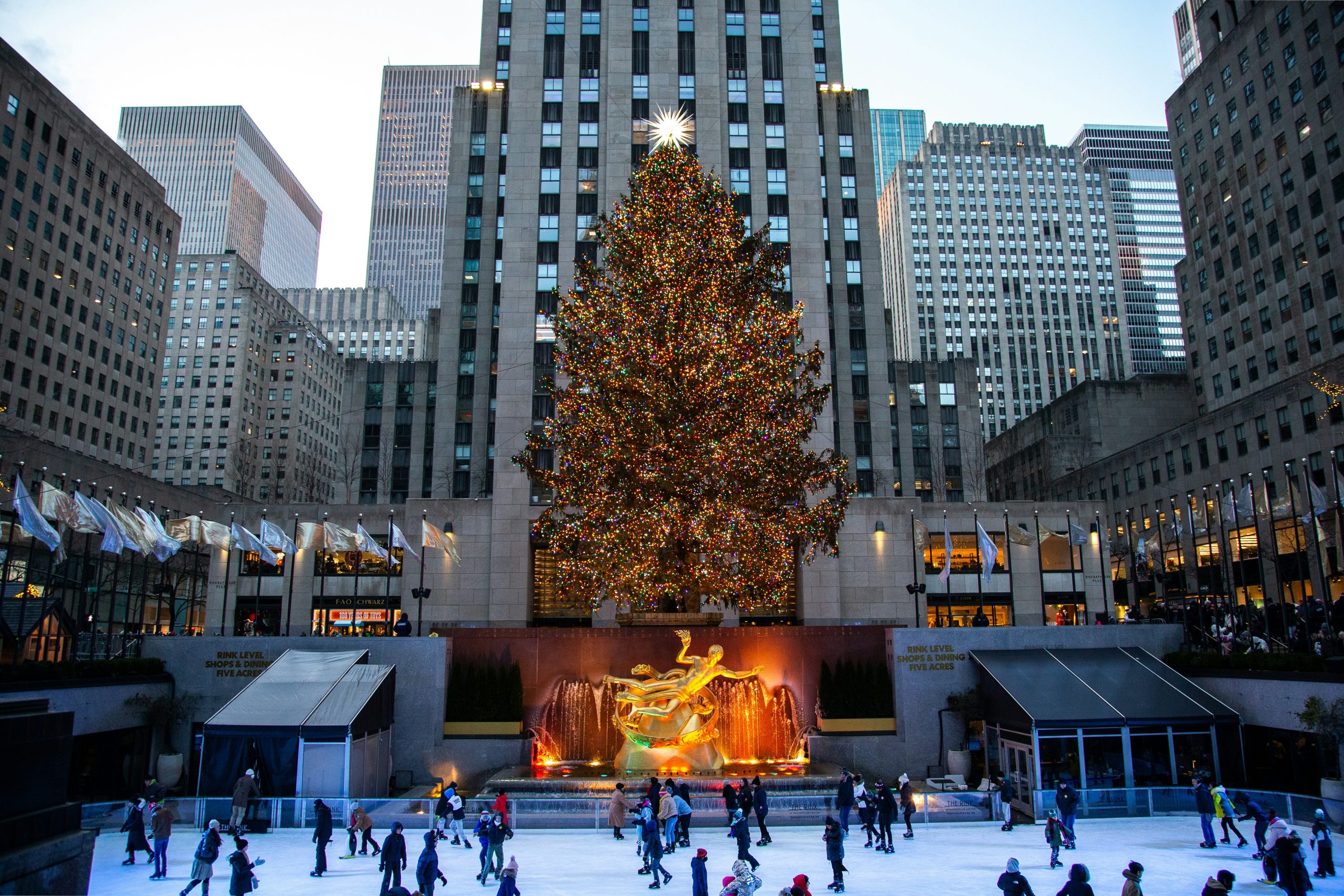
The tree stands on Center Plaza at Rockefeller Center, between Fifth and Sixth Avenues, from 49th to 50th Street. It is a seventy-six-foot Norway spruce from West Edmeston, with fifty thousand LEDs and a Swarovski star at the top. But it is not the only thing that makes Christmas special: the city gathers around it. It is an anchor, the center of gravity around which December revolves, but the city is a living, eating, singing, skating, shopping organism, and the Christmas season is when it shows itself at its most unrestrained.
The tree for 2026 arrived on November 7, and the lighting ceremony will take place on Wednesday, December 2, from seven to ten o’clock in the evening. The ceremony is closed to the public; it is televised by NBC, and if you’re wise you’ll watch it at home or wait a day and go down to the plaza on a weekday evening when the crowds are thin and the lights—there are fifty thousand of them—can be seen without anyone else’s shoulders. The tree remains on display through mid-January, so the idea that you have to see it on any given day is only an illusion; it’s a long Christmas.
The matter is how you spend the season, and in New York that is always a negotiation between the iconic and the intimate. The rink under the tree at Rockefeller Center is the classic Christmas scene, and it’s worth trying at least once, preferably in the early or late hours, when the line gets shorter and the ice opens up. But Bryant Park’s Winter Village offers something the Rockefeller rink can’t: a 17,000-square-foot ice surface with free admission, ringed by over 180 shops and a rinkside bar called The Lodge, serving mulled wine and cocoa with the New York Public Library in the background. The market runs from late October through early January, while the rink lasts until the end of February, so the skating outlasts the shopping. And the private heated igloos, which you can book for 90-minute sessions with Bavarian pretzels and hot cider, bring a festive European Christmas market fantasy to the skyscrapers.
The markets themselves are the main circulation in the city during December. Union Square’s Holiday Market, dating from the early 1990s, has nearly two hundred vendors, including a Made in NYC booth where six local businesses have rotating week-long residencies. The Columbus Circle market is a quieter option, tucked beside Central Park, not as crowded as Bryant Park on a weekend night and conveniently close to the Shops at Columbus Circle’s Holiday Under the Stars display. In bad weather the Grand Central Holiday Fair goes indoors, and for something a bit more local, there’s also the FAD Market, which moves through Brooklyn, spending the longest time at Empire Stores in Dumbo, from late November through December 20. The charm of these markets lies not only in the prospect of finding something to buy—although it is a great temptation—but in being part of the ritual, the special pleasure of browsing among the lights, drinking cocoa, feeling the cold air on your face, and being outside by choice rather than need.
The two tracks of gastronomic life in New York at Christmas are the restaurants that make the holiday their business, and the city’s general belief that a good meal is a right in all circumstances. The greatest test is Christmas Day, for while Paris and London largely go quiet on the 25th, New York continues to serve those who do not cook or celebrate in the conventional way, a tradition that includes hotel dining, steakhouses, and Chinese restaurants. The standard-bearer of the Chinese Christmas dinner is Joe’s Shanghai in Chinatown, now at 46 Bowery, with its crab and pork soup dumplings. Cote, the Michelin-starred Korean steakhouse in the Flatiron, confirms Christmas Day service and offers its Butcher’s Feast—four cuts of USDA Prime and wagyu grilled at the table—as perhaps the most ambitious holiday dinner. Balthazar in SoHo is open as usual on Christmas Eve and Christmas Day, with its zinc bar and red leather banquettes, serving plateau de fruits de mer and steak frites in the most Parisian room New York has built. Gallaghers in the Theater District, open since 1927, dry-ages its porterhouse behind glass on the sidewalk and serves it all day on Christmas Day. Red Rooster in Harlem, Marcus Samuelsson’s upscale soul food restaurant, is open every day of the year, with fried chicken, cornbread, and usually live music on Christmas. Tavern on the Green offers the Central Park fantasy, with a four-course prix fixe around $135 and the park potentially dusted white beyond the Crystal Room windows.
For those who prefer the festive feast on Christmas Eve instead of Christmas Day, the choices at the city’s restaurants are almost inexhaustible: Aquavit’s Nordic tasting menu, Dirty French’s duck à l’orange, the Russian Tea Room’s eighty-year-old theatricality, Smith & Wollensky’s steaks—these are not Christmas-specific but New York institutions that happen to be open, which is precisely the city’s gift to a visitor who has nowhere else to go. And the Christmas markets, in their way, are also nourishing: The Lodge at Bryant Park, the stalls in Union Square, the pretzels and cider and mulled wine, which, if eaten with sufficient conviction, constitute a substantial meal.
Music is the third pillar, and in December the concert halls and churches are instruments of the season. On December 6, the six hundred choristers of the Young People’s Chorus of New York City will fill David Geffen Hall with a program blending holiday classics, world music, and new arrangements, and on December 17 they will go to St. Patrick’s Cathedral to present “A City Singing at Christmas,” a free event of cherished carols beneath the cathedral’s vaulted ceiling, open to anyone willing to stand in the cold for a seat. The New York Philharmonic will give holiday concerts from December 9 to 20, including Handel’s Messiah, family programs, and a Harry Potter film with live orchestral accompaniment. The Knights, Brooklyn’s boundary-agnostic chamber orchestra, will give “The Knights Before Christmas” at Town Hall on December 13, combining Paul Simon favorites with a Bach Brandenburg Concerto and holiday sing-alongs, an arrangement that sounds absurd on paper but works because the Knights have built a reputation for making unlikely pairings seem inevitable. Carnegie Hall, Jazz at Lincoln Center, and the Metropolitan Opera also offer festive programming, while the Radio City Rockettes continue their Christmas Spectacular with the precision and scale that have made it a generational ritual. Alvin Ailey’s Revelations is performed at New York City Center from early December to early January, a moving holiday tradition that has become as closely associated with the season as a tree or carol.
In New York at Christmas, the best experiences are to be found outside Midtown. The Upper West Side, with Lincoln Center and Central Park at its edges, is a good place for families; in Brooklyn you will find DUMBO’s views and the Brooklyn Nutcracker, a local reimagining of the classic ballet. In Harlem there is Red Rooster and a Christmas rooted in neighborhood rather than spectacle; in Greenwich Village and on the Lower East Side are independent shops and restaurants where the Christmas season follows its own schedule. These are less harried than the department stores, more likely to offer a seat and a drink to a stranger who looks cold. Christmas in New York is not one experience but a multitude of experiences layered one on top of the other. The visitor who chases the tree and nothing else will find himself on December 26 wondering what happened to the holiday.
The tree is on Center Plaza, and it is beautiful. But the city around it—the dumplings in Chinatown, the carols at St. Patrick’s, the skaters in Bryant Park, the choristers at Geffen Hall, the steaks at Gallaghers, the igloos, the mulled wine, and the fifty thousand lights—is the real thing. Christmas in New York isn’t a destination. It’s a set of simultaneous invitations, and the only mistake is accepting just one.
ELENA MAKREE
for more
- Rockefeller Center Official Website
https://www.rockefellercenter.com/magazine/events/the-virtual-lighting-before-christmas/
Provides official information on the 2026 Christmas tree lighting time (December 2, 7–10 PM), tree specifications (76-foot Norway spruce, 50,000+ LED lights), viewing methods, and NBC broadcast details. - Bryant Park Official Website
https://bryantpark.org/activities/bank-of-america-winter-village-at-bryant-park
Provides official information on Winter Village’s operating hours (October 28, 2026–February 28, 2027), ice rink, The Lodge food and beverage area, and holiday shops. - Resy Reservation Platform – The Mark Restaurant by Jean-Georges Christmas Day Page
https://resy.com/cities/new-york-ny/venues/the-mark-restaurant-by-jean-georges/events/christmas-day-2026-2026-12-25-6
Provides specific information on Christmas Day (December 25, 2026) restaurant offerings, including three-course prix fixe pricing ($258/person) and reservation policies.