



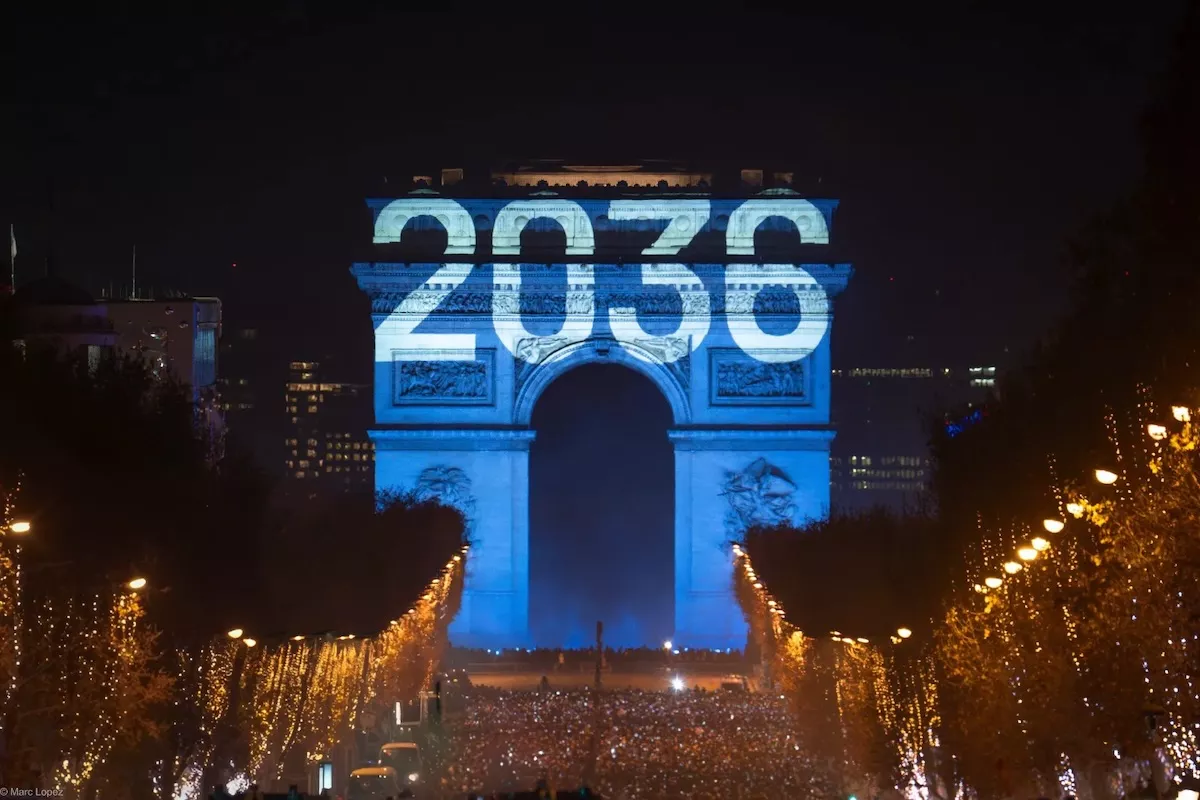
The first rule of New Year’s Eve in Paris is to look up. Up at the fireworks dancing around the Arc de Triomphe. Up at the dizzying sparkle of the Champs-Élysées illuminations. Up at the hopeful, expectant faces of a million strangers-turned-friends as they hold their breath and wait for the future to begin.
And at 11:59 PM on December 31, 2025, an entire city did exactly that. They looked up. Phones were raised. Champagne flutes were held aloft. A hush, pregnant with possibility, fell over the City of Light as the final ten seconds of the year began their march across the giant screens.
“Ten! Nine! Eight!”
A sea of voices, unified in joyful cacophony.
“Three! Two! One!”
An eruption. Fireworks painting the sky in gold and purple. Kisses. Cheers. The thunderous, collective sigh of a fresh start.
And then, as the smoke cleared and the first wave of “Happy New Year!” wishes washed over the crowd, people squinted. They nudged their neighbors. They pointed.
There, on the official, city-sponsored, can’t-miss-it digital display arching over the celebration, in bold, shimmering, celebratory type, were not the digits everyone expected.
It didn’t say 2026.
It said 2036.
For a glorious, utterly baffling moment, Paris had accidentally catapulted itself—and everyone in it—a full decade into the future. The greatest, most stylish, and most French time-travel incident in history had just occurred, not with a whirring DeLorean, but with a presumably very stressed-out municipal web developer and a misplaced semicolon.
Welcome, mes amis, to the year 2036. You’re already here. Let’s see what we missed.
The Immediate Aftermath: Panic, Confusion, and Opportunistic Champagne Sales
In the seconds following The Great Display Debacle, human nature took over.
- The Optimists: “Darling, does this mean we’re ten years closer to retirement? Magnifique!” (Immediately opens another bottle.)
- The Pessimists: Checks their phone calendar frantically, convinced they’ve somehow slept through a decade of mortgage payments and soccer practices.
- The Entrepreneurs: A nearby kiosk vendor, with lightning speed, slaps a hand-written “BIENVENUE EN 2036” sign over his “Bon 2026” banner and jacks up the price of warm Champagne by 300%. Some things, it seems, are timeless.
The official fireworks show went off without a hitch, but let’s be honest, everyone was a bit distracted. They were beautiful, sure, but were they… futuristic enough? People weren’t sure what to look for. Were there laser-shooting drones? Holographic baguettes? No one knew, because we were all too busy living in the moment—a moment that was, according to the authorities, ten years from now.
A Tourist’s Guide to Paris, 2036 (According to a 2026 Glitch)
So, what does this accidental prophecy tell us about Paris a decade from now? As your dedicated—and now chronologically confused—Hoptraveler correspondent, I’ve pieced together the most likely advancements based on the city’s current trajectory and sheer, unadulterated Gallic pride.
1. Transportation: The Flying Baguette is Still “En Développement”
Despite the promise of 2036, the RER B line from Charles de Gaulle is still experiencing “un slight retard.” However, sources suggest the delays are now due to “synchronizing hyper-loop tubes with traditional rail.” Sure. We believe you. The big news is the citywide network of Trottinettes de l’Air (Air Scooters). They’re silent, electric, and programmed to politely say “Pardon” before almost clipping your ear as they zip toward Montmartre. The traditional Metro, now classified as a “moving heritage experience,” requires a special vintage day-pass and smells faintly of 2024-era parfum and nostalgia.
2. Culinary Evolution: The Bistronomy Singularity
The classic Parisian bistro has achieved its final form. Menus are now beamed directly to your optic nerve via a nano-projector in your complimentary bread basket. You can taste the coq au vin before ordering, a feature that has reduced food waste to zero but increased existential dread among chefs by 400%.
The biggest revolution is at the bakery. The 3D-Printed Viennoiserie kiosk is on every corner. For €15, you can get a “Artisanal, Algorithmically-Perfect Croissant” printed with edible, bioluminescent glaze that shows the day’s weather forecast. Purists, of course, still queue for 45 minutes at a hidden boulangerie in the 11th where a 120-year-old sourdough starter, named Pierre, makes all the decisions.
3. Cultural Must-Sees: The Louvre 2.0 & Immersive Pasts
The Louvre has finally finished its renovations. The new underground wing, Le Département des Influences Perdues, is dedicated entirely to forgotten Instagram trends from the early 21st century. The Mona Lisa has a quiet, climate-controlled room to herself, while a 50-foot hologram of a 2015 “Food Porn” avocado toast installation draws record crowds next door.
Meanwhile, immersive art experiences have evolved. You can now don a sensory suit and become a painting at the Atelier des Lumières. Their winter 2036 exhibition, “Gaulish Grunge: The Lost Years of Asterix,” lets you feel the spray of magic potion and smell the wild boar roasting over an open fire. It’s educational, if slightly damp.
4. The Enduring Light Show (Now with 100% More Holograms)
Paris will always be the City of Light. By 2036, the Christmas illuminations on the Champs-Élysées are a year-round, dynamic art installation. The 400 trees are wrapped in adaptive LED bark that changes color with the city’s collective mood (a lot of muted grey on Monday mornings). The annual light show, now choreographed by an AI trained on the works of Monet and Daft Punk, is a 15-minute spectacle where holographic phoenixes made of light erupt from the Arc de Triomphe every evening.
5. New Year’s Eve 2036: A Calm, Orderly, and Slightly Boring Affair
In a shocking twist, the famed New Year’s Eve concert on the Champs-Élysées has been permanently cancelled. After years of million-person crowds, the city decided the risk of “collective joyousness causing a stampede” was too great. Instead, the official celebration is a state-produced, 4K holographic concert beamed directly into your apartment, starring a digitally-rendered, forever-young Serge Gainsbourg.
The midnight fireworks, however, remain sacred. They are now launched by silent drones that paint intricate, ephemeral portraits of famous French philosophers in the sky. Watching Sartre’s face explode in a shower of existential blue sparks is, they say, a truly profound experience.
The Grand Conclusion: The Glitch That Taught Us Everything
As the sun rose on January 1st, 2026 (or was it 2036?), the digital display was fixed. The future had been gently reeled back in. But something lingered in the Parisian air—a shared secret, a collective wink.
Because Paris 2036, according to our accidental preview, isn’t about jetpacks and robot butlers. It’s about a city so confident in its soul that its idea of progress is a slightly better croissant, a much prettier light show, and finding a way to make even philosophical despair look beautiful in the night sky.
The glitch didn’t show us a strange new world. It showed us Paris, just more so. And the greatest lesson of all? No matter what the calendar says, the best way to experience the future is to be right here, in a timeless city that masters the art of living, one beautiful, chaotic, and occasionally mistaken moment at a time.
So, raise a glass—whether it’s 2026 or 2036. À la vôtre! Here’s to the next ten years. According to Paris, they’ve already started, and they look très, très chic.
The Real Reason 2036 Came Early:
The projection at the Arc de Triomphe on New Year’s Eve was a powerful campaign by chef Yannick Alléno. The 2036 displayed on the monument symbolized a goal: a year by which such senseless loss of life on the roads could be drastically reduced or even eliminated, turning a global celebration into a moment of vital, life-saving awareness.