



Forget the sprawling capitals for a moment. This isn’t about the Eiffel Towers, the Roman Forums, or the pulsing crowds of New York or Tokyo. We’re here to talk about the places you might miss if you blink—the small cities and towns where beauty isn’t a landmark you visit, but the very air you breathe. Where “rush hour” means pausing to let a cat cross the cobblestone street. Where having a population under 150,000 isn’t a limitation, but the secret ingredient to their timeless charm. These are not just dots on a map; they are destinations for the soul, each a perfectly preserved snow globe of culture, history, and sheer, breathtaking loveliness. Pack your most comfortable walking shoes and a sense of wonder, and join us on a grand tour of the world’s most beautiful small cities.
Hallstatt, Austria: The Original Fairy-Tale Village
Let’s start with a town so ridiculously picturesque it inspired a full-scale replica in China. Nestled on the shores of the Hallstätter See and cradled by the Dachstein Mountains, Hallstatt looks like it was sketched by a storybook illustrator on a particularly inspired day. It’s a UNESCO World Heritage Site, but its designation feels almost redundant. The beauty here is so obvious it needs no committee to validate it.
The charm is in the harmony: pastel-colored houses with flower-filled balconies cling to a mountainside, their reflections shimmering perfectly in the deep blue lake below. You can wander its compact lanes, visit the Hallstatt Museum to learn about its prehistoric salt-mining past, or take the funicular up to the Skywalk Hallstatt for a dizzying, panoramic view that will make you gasp. It’s a place that proves perfection is possible, provided it comes in a very small, alpine-wrapped package.
Rothenburg ob der Tauber, Germany: The Living Postcard
If you’ve ever dreamed of walking into a medieval painting, Rothenburg ob der Tauber is your portal. Encircled by completely intact, walkable town walls and watched over by stout watchtowers, this Franconian gem hasn’t just preserved its history; it lives and breathes it. Wandering its cobblestone streets, past half-timbered houses leaning in as if to share a secret, you half-expect a knight to clatter past.
The scent of baking leads you to the town’s famed Schneeballen (snowball pastries), and the sound of music might guide you to one of its enchanting festivals. Visit the Käthe Wohlfahrt Christmas Museum—yes, a year-round Christmas museum—and you’ll understand why this town is the beating heart of Germany’s festive spirit. Rothenburg isn’t just beautiful; it’s an immersive, time-traveling experience where every corner is a photo waiting to be taken.
Eze, France: The Riviera’s Eagle’s Nest
Perched like a stone crown atop a sheer cliff on the French Riviera, Eze offers a different kind of beauty—one of dramatic vistas and refined, sun-drenched elegance. This medieval village is a maze of narrow, winding lanes that curl upwards, past artisan galleries and tiny boutiques, towards the sky.
The reward for the climb is the Jardin Exotique d’Eze, a breathtaking botanical garden where cacti and succulents cling to the cliffside, framing panoramic views of the Mediterranean that stretch all the way to Corsica on a clear day. It’s a place of intoxicating contrasts: ancient stone against the endless blue sea, the quiet rustle of exotic plants against the distant sound of waves. For a touch of luxury, stay at the legendary Château Eza, a hotel built into the fortress walls, where you can sip a glass of rosé and feel like royalty surveying your domain.
Oia, Greece: The Sunset Capital of the World
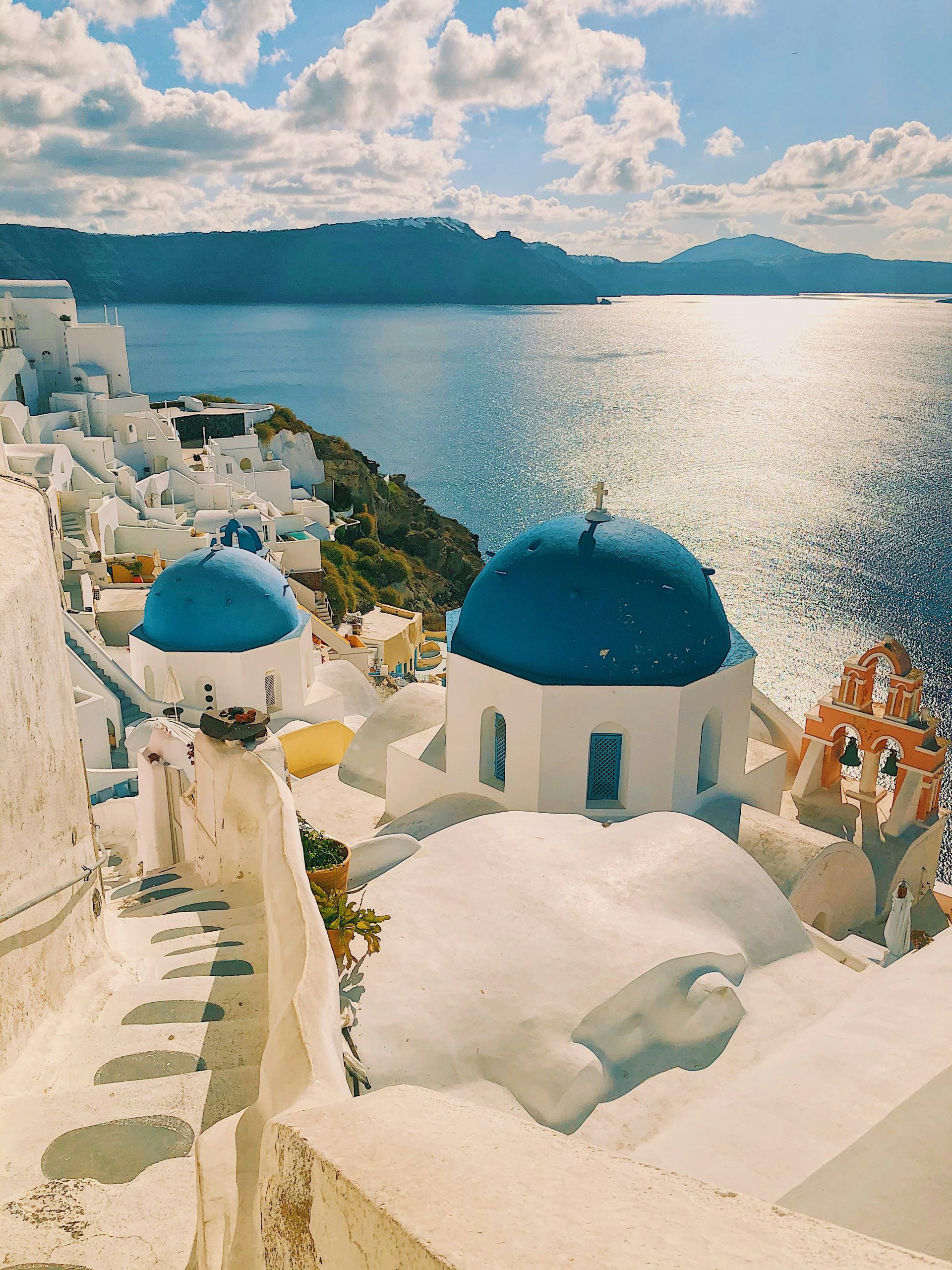
Some towns are defined by a single, daily masterpiece. For Oia, on the caldera of Santorini, that masterpiece is the sunset. As day softens into evening, the entire whitewashed village, with its iconic blue-domed churches and cave houses carved into the volcanic rock, becomes a front-row seat to one of nature’s greatest shows. The sky erupts in hues of orange, pink, and gold, reflecting off the cobalt Aegean Sea, while visitors and locals alike fall into a reverent silence.
But Oia’s beauty isn’t just sunset-deep. By day, explore its boutique-lined paths, discover its maritime history, or simply lose yourself in the maze of dazzling white architecture against the impossibly blue sky. It’s a stark, elemental beauty—fire, water, earth, and air—all composed into a vision of Cycladic perfection.
Trogir, Croatia: The Stone Phoenix on the Adriatic
Just a short drive from the bustling city of Split lies Trogir, a tiny island-city connected by bridges to the mainland and to the larger island of Čiovo. What it lacks in size, it more than makes up for in historical density. A UNESCO World Heritage Site, Trogir is often called a “living museum” because its continuous urban fabric spans over 2,300 years, from the Greeks to the Romans, Venetians, and beyond.
Its labyrinthine old town is a masterpiece of Romanesque and Renaissance architecture. The radiant Cathedral of St. Lawrence, with its famous Radovan’s Portal, is a highlight, but the true joy is getting lost in the shadowy, marble-paved alleys, emerging into sun-drenched piazzas, and stumbling upon a quiet konoba (tavern) for fresh Adriatic seafood. It’s a humbling beauty, built stone by stone across millennia.
Albi, France: The Crimson Fortress of the Midi
In the verdant Tarn region of southwestern France, the “Episcopal City of Albi“ rises from the riverbanks in a stunning statement of burnt-red brick. Dominated by the formidable, fortress-like Cathédrale Sainte-Cécile—the largest brick building in the world—Albi presents a beauty that is powerful, austere, and deeply historical.
This UNESCO site was a stronghold of the Cathar faith, and its architecture feels both defensive and devotional. Yet, within these stern walls lies a delightful contrast: the Toulouse-Lautrec Museum, housed in the stunning Berbie Palace, celebrates the playful, provocative art of the town’s most famous son. Wandering from the cathedral’s breathtaking Italian frescoes to Lautrec’s posters of Parisian nightlife is a journey through the full spectrum of human expression, all contained within one uniquely beautiful, brick-red city.
Marsaxlokk, Malta: The Painted Harbour
Swap stone and brick for the vibrant, sun-faded colors of a fishing village. Marsaxlokk, on Malta’s southeastern coast, is a symphony in hue. Its harbor bobs with luzzu—traditional wooden fishing boats, each painted in bright blues, yellows, and reds, and adorned on the prow with the protective “Eye of Osiris”.
The beauty here is active, salty, and delicious. On Sunday mornings, the Marsaxlokk Fish Market transforms the waterfront into a bustling spectacle where you can buy the day’s catch straight from the boats. The scent of the sea mixes with grilled octopus and simmering tomato sauces from waterfront restaurants. It’s a working town where beauty is woven into daily life—in the patina of the boats, the laundry fluttering from balconies, and the deep-blue Mediterranean that cradles it all.
Rye, England: The Time-Capsule of East Sussex
Stepping into Rye is like stepping into a particularly well-maintained chapter of English history. Once a Cinque Port surrounded by sea, it now sits two miles inland, a cobbled hilltop jewel. Its beauty is one of romantic, slightly crooked antiquity.
Walk down Mermaid Street, arguably England’s prettiest, where 15th-century half-timbered houses with sagging roofs and ancient doorways lean at improbable angles. Explore the Ypres Tower for views over the Romney Marsh, and get lost in stories of smugglers and siege. Rye’s charm is gentle, literary, and profoundly cozy—the perfect place to curl up in a timbered inn with a book after a day of time-travel.
Clarens, South Africa: The Mountain’s Golden Jewel
Tucked at the foothills of the Maluti Mountains in the Free State, Clarens offers a beauty of a wilder, more expansive kind. Nicknamed the “Jewel of the Free State,” it’s famed for its dramatic sandstone cliffs and formations that glow with golden and reddish hues, especially at sunrise and sunset.
This is a town for artists, hikers, and anyone who finds solace in big skies and majestic landscapes. The surrounding Golden Gate Highlands National Park is a wonderland of hiking trails and unique rock formations. Clarens’ beauty is not in ancient architecture but in its raw, natural canvas—a place where the air is clean, the horizons are wide, and the mountains tell ancient stories.
Valletta, Malta: The Miniature Baroque Metropolis
We bend our population rule ever so slightly for Valletta, but it’s a necessary exception. The Maltese capital is technically a small city, but it packs more grandeur per square foot than any place on Earth. A UNESCO World Heritage Site described as “one of the most concentrated historic areas in the world,” Valletta is a masterpiece of Baroque architecture built by the Knights of St. John.
Walking its grid-patterned streets feels like traversing an open-air museum of honey-colored limestone. Every corner reveals a cathedral, a palace, or a garden with stunning harborside views. From the opulence of St. John’s Co-Cathedral to the fortifications of the Upper Barrakka Gardens, Valletta proves that a city doesn’t need to be large to feel monumental. It is, quite simply, a small city with the soul of a great empire.
In the end, the magic of these small cities lies not just in what you see, but in what you feel: the slower pace, the tangible history, the connection to a unique landscape or culture. They remind us that sometimes, the most profound beauty comes in small, unforgettable packages. So, on your next adventure, dare to think smaller. The world’s grandest treasures often are.
BY ELENA MAKREE