



You love Italy. You dream of its food, its history, its effortless beauty. But the thought of another trip to Rome, Florence, or Venice? The crowds, the queues, the prices, the feeling that you’re just one more sardine in an increasingly expensive tin?
There’s a better way. And it’s called Bologna.
I’ll say it straight: Bologna is the best-value destination in Italy right now. Not just “affordable” in the way that hostel dorms are affordable. I mean genuinely, surprisingly, almost-embarrassingly good value for the quality you get. A city where you can eat world-class pasta for pocket change, stay in the historic center without remortgaging your home, and experience authentic Italian life without fighting through selfie sticks to do it .
Let me show you why Bologna should be at the top of your 2026 travel list.
The City with Three Nicknames (And All of Them Fit)
The Bolognese have a charming habit of giving their city affectionate nicknames. You’ll hear them everywhere, and unlike most tourist-board branding, these actually make sense once you’re here .
“La Rossa” (The Red) – This one’s obvious the moment you arrive. The entire historic center glows in warm terracotta, a unified architectural palette that makes every street feel like a painting. It’s not just the buildings; it’s the political history too, but honestly? You’ll be too busy photographing the sunset on those red tiles to care about 20th-century politics .
“La Dotta” (The Learned) – Home to the oldest university in the Western world, founded in 1088. Dante studied here. Copernicus studied here. Today, 85,000 students keep the city vibrating with an energy that’s infectious and, crucially, keeps prices low because demand is driven by student budgets, not tourist dollars .
“La Grassa” (The Fat) – And here’s where it gets really interesting. This is Italy’s culinary capital, and the locals wear that title with pride. You’re not visiting a city; you’re visiting a four-course meal with really good architecture on the side .
The Numbers That Actually Matter
Let’s talk money, because that’s why you’re here.
A comfortable daily budget in Bologna runs about $104–$150 per day. That includes a nice hotel, three meals, a couple of museum tickets, and maybe a gelato or two . For comparison, that’s roughly 30% less than Rome, and about half what you’d spend in Venice .
Want to eat well? Lunch in a trattoria runs $12–$18. Dinner, maybe $20–$30 with wine. A gelato from one of the legendary spots? About $3–$5 . The Mercato delle Erbe will sell you picnic supplies that put most restaurant meals to shame for pocket change .
And here’s the kicker: none of this requires weeks of advance planning. In Bologna, you just… show up. You find a table. You eat well. You don’t book three months ahead or queue for an hour .
What to Do: The Bologna Bucket List
Climb the Asinelli Tower (If You’re Brave Enough)
The Two Towers are Bologna’s leaning answer to Pisa, and they’re leaning quite dramatically, thank you very much . The taller one, Torre degli Asinelli, offers 498 wooden steps to the top. No elevator. Just you, medieval stairs, and the very real sense that you’re climbing history .
The reward? A view over those red rooftops that will make your Instagram followers weep with envy . €5 entry, open Wednesday to Monday. Go early, or go for sunset, but go .
(The shorter tower, Garisenda, is currently closed for structural concerns. It’s leaning so much they’re genuinely worried. You can still admire it from below and feel grateful you’re not living in 12th-century Bologna when 100 of these things were competing for sky dominance.)
Walk the Longest Portico in the World
Bologna has 62 kilometers of porticoes – covered walkways that line the streets and shelter you from rain and sun. They’re a UNESCO World Heritage site, and they’re free to explore .
The crown jewel is the Portico di San Luca: 3.8 kilometers of continuous arches (666 of them, if you’re counting) climbing from the city center to the Sanctuary of the Madonna di San Luca on the hill above .
It’s a 45-60 minute walk uphill – moderately steep, completely covered, and almost entirely free of tourists. Most visitors don’t make the trek. You should. The view from the top is your reward, and the walk itself is meditative, peaceful, and deeply Bolognese .
(Can’t handle the climb? There’s a tourist train. But honestly? Walk it.)
Piazza Maggiore: The Living Room of Bologna
Every Italian city has its main square. Bologna’s is special. Flanked by the unfinished facade of the Basilica di San Petronio (originally planned to rival St. Peter’s in Rome until the Vatican politely intervened), the square is where Bologna gathers .
The basilica itself is free to enter. Inside, you’ll find a massive sundial and Gothic chapels that reward a slow wander . The square comes alive at sunset, when students gather on the steps, buskers perform, and the surrounding cafes fill with the clink of aperitivo glasses .
Get Lost in the Quadrilatero
This is where Bologna’s food soul lives. The Quadrilatero market district is a maze of narrow medieval streets just east of Piazza Maggiore, lined with food shops, delis, and market stalls that have been here for centuries .
Hams hang from ceilings. Wheels of Parmigiano-Reggiano aged 24 months or more sit like golden treasures. Pasta makers (sfogline) roll fresh dough in shop windows, their hands moving with generations of practice .
Come in the morning. Buy a picnic. Eat it somewhere beautiful. This is not a suggestion; it’s an instruction.
The Secret Canal and Other Hidden Joys
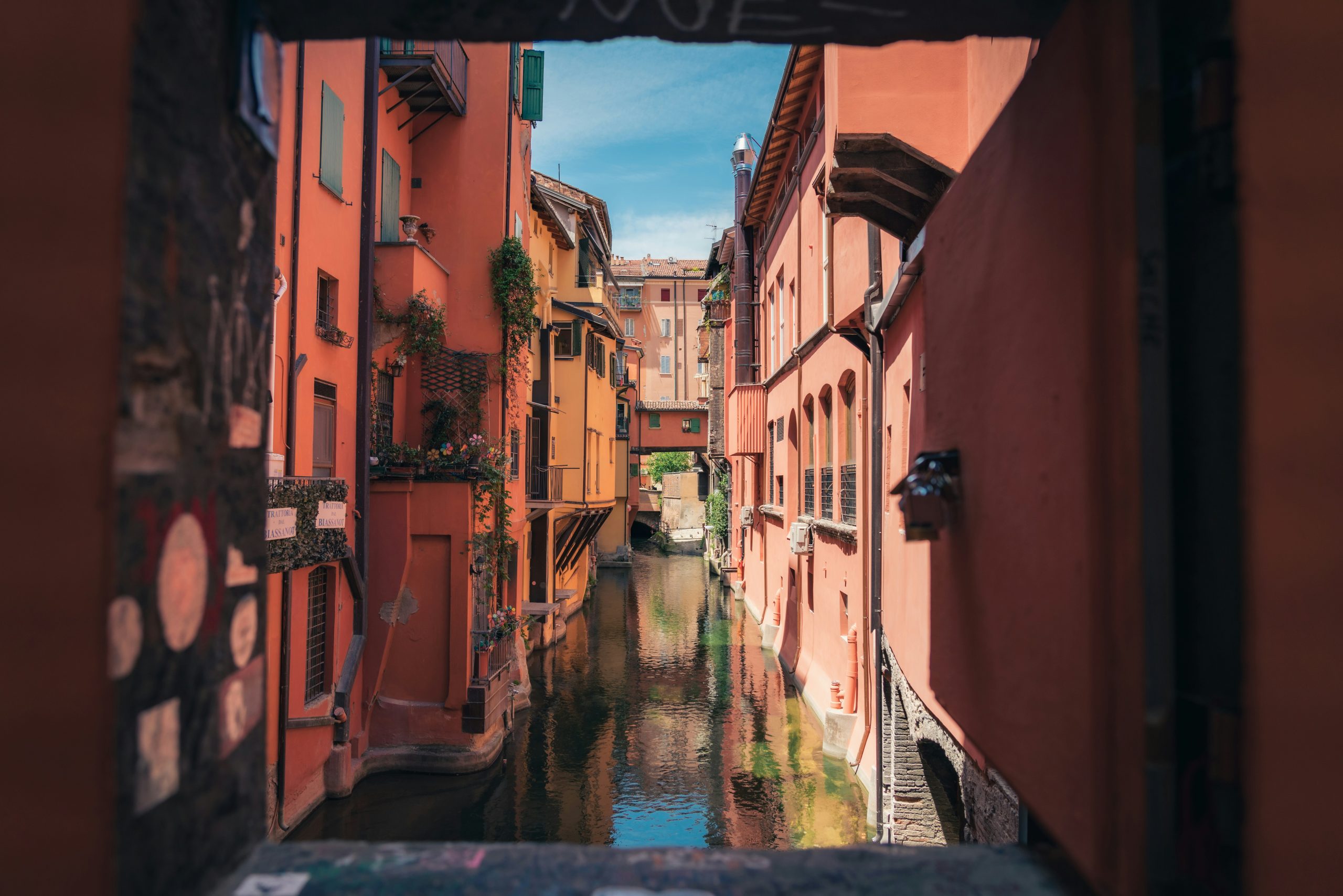
Bologna once had canals like Venice. Most are gone now, but a secret remains. At Via Piella, look for a small window (the Finestrella). Peek through, and you’ll see a hidden waterway that feels like stepping into another century .
It’s ridiculous. It’s wonderful. And it’s completely free.
Where to Eat: A Serious Matter
Bologna takes food seriously. You should too.
First, a rule: Never, ever order “spaghetti bolognese.” It doesn’t exist here. Locals will visibly cringe. The real dish is tagliatelle al ragù – fresh egg pasta with a slow-cooked meat sauce that bears no resemblance to the jarred stuff you know .
Other essentials:
- Tortellini in brodo – tiny meat-filled pasta parcels in rich broth. Perfection .
- Lasagne verde – made with spinach pasta, because Bologna does everything better .
- Mortadella – the original, glorious version of what you wrongly call “bologna” .
Where to eat:
- Osteria dell’Orsa – Communal tables, massive bowls of pasta, €12–€18 mains. No reservations, just show up .
- Sfoglia Rina – Counter dining, open kitchen, fresh pasta made before your eyes. Solo-traveler heaven .
- Trattoria di Via Serra – Authentic, family-run, and wonderful .
- Da Cesari – Slightly more formal, still reasonably priced, excellent traditional cooking .
Gelato: Cremeria Funivia and Sorbetteria Castiglione are legendary. Cremeria Cavour is often called one of the best in the world . €2.50–€5 for joy in a cup.
Aperitivo: From 6–8 PM, order a drink (spritz, €7–€10) and get access to a buffet that can easily substitute for dinner. The university district along Via Zamboni and the streets off Via del Pratello are prime territory .
Where to Stay
Centro Storico is your friend. Stay near Piazza Maggiore or Via dell’Indipendenza, and everything is within walking distance .
- Budget: Albergo delle Drapperie, clean and central, €70–€120/night .
- Mid-range: Hotel Metropolitan, modern rooms with breakfast, €110–€250/night .
- Hostel: Combo Bologna – feels more like a boutique hotel with a garden, perfect for solo travelers, just a short bus ride from center. Book ahead .
When to Visit
April–June and September–October are perfect. Temperatures 15–25°C, skies clear, crowds manageable .
July–August can hit 35°C, and many locals flee to the coast, leaving some restaurants closed in mid-August .
Winter is quieter, chillier (5–10°C), and still charming – especially if you want the city to yourself .
Getting There and Around
Fly into Bologna Guglielmo Marconi Airport (BLQ) . The Marconi Express train gets you to the central station in 7 minutes for €12.80. Taxis run €18–21 .
The city center is exceptionally walkable. Everything is within 30 minutes on foot, and those porticoes mean you’re sheltered from weather .
Buses run by TPER cost €2.30 (single) or €6 (day pass) . But honestly? Walk. That’s the point.
Day Trips: Because You Can
Bologna’s train station is a hub. Florence is 35 minutes away. Milan, 1 hour. Venice, 1.5 hours. Verona, 1 hour .
For shorter hops: Modena (20 minutes) for balsamic vinegar and supercars. Parma (50 minutes) for ham and cheese. Ravenna (1 hour) for Byzantine mosaics that will make your jaw drop. If you want to make those day trips even smoother, consider skipping the train schedules altogether and booking a private car instead. You’ll travel door-to-door between cities like Modena, Parma, or even Florence, with the added bonus of stopping at smaller hidden gems you’d otherwise miss.
The Bottom Line
Bologna in 2026 isn’t just a good idea. It’s the smart move.
It’s the city where you eat better than anywhere else, pay less than anywhere else, and experience Italy as it actually lives – not as it performs for tourists. It’s students arguing over Lambrusco in piazzas, grandmothers rolling pasta in shop windows, and 62 kilometers of porticoes waiting for your footsteps .
Rome will still be there. Florence will still be crowded. Venice will still be sinking.
But Bologna? Bologna is waiting. And it’s affordable. And it’s delicious. And it might just be the best travel decision you make all year.
Practical tip before you go: Learn “Buongiorno” and “Buonasera.” They go a long way in small shops and trattorias. And eat more tortellini than seems wise. You won’t regret it.