


You land in Warsaw, Budapest, or Lisbon. Your meeting starts in 90 minutes. The signage is in a script you can’t read, the taxi driver speaks no English, and your translation app just gave you something that sounds grammatically wrong.
This is not a traveler’s anecdote. It is a daily operational reality for millions of business professionals, marketers, and executives working across European language markets. And the stakes are higher than most people acknowledge.
Why This Matters Now
Cross-border business travel reached 1.4 billion trips in 2024. The European Union alone operates across 24 official languages. Remote-first teams now work across time zones where different languages are in play every single day.
Yet most professionals still rely on tools built for casual conversation, not professional communication. The gap between good enough for directions and accurate enough for a client meeting is exactly where trust is lost and where deals fall apart without anyone understanding why.
Research from CSA Research found that 65% of consumers prefer content in their native language, and 40% will not buy from websites in other languages at all. That dynamic does not disappear in B2B contexts. It just becomes harder to trace when a relationship quietly stalls.
What This Guide Covers
This guide is for professionals navigating non-English European environments, whether in person or in writing. It covers the tools available today, how to use them effectively, where they fail, and how to communicate with genuine confidence rather than hoping for the best.
What Does Language Confidence Actually Mean in a Professional Context?
Language confidence is not fluency. It is the ability to communicate your intended meaning accurately enough that the other party understands it as you meant it — not as the tool interpreted it.
For executives and marketers, this means three things: accurate written translation of documents and communications, reliable real-time conversation support, and the judgment to know when AI tools are sufficient and when human expertise is required.
Most professionals get the first and third right. It is the middle category, written communications produced under time pressure, where errors are most likely to occur and least likely to be caught.
Why Do AI Translation Tools Still Fail Professionals?
Single-engine AI translation produces inconsistent results across language pairs. A tool trained heavily on English-Spanish data will perform very differently on English-Polish or English-Hungarian pairs.
The specific failure mode for professionals is not obvious errors. It is plausible errors. A sentence that sounds correct but uses the wrong register, the wrong honorific, or the wrong technical term can undermine a negotiation without either party understanding why.
Europe compounds this problem. Polish, Hungarian, Finnish, Czech, and Romanian all have complex morphology that most consumer translation tools handle inconsistently. A single mistranslated term in a contract or proposal can change its meaning entirely.
How Does Modern AI Translation Work and What Are Its Limits?
Most AI translation tools use a single neural machine translation engine. You input text, the model produces an output, and you receive one version with no indication of how confident the model is or where it may have guessed.
The limitation is that different models make different errors. One engine may handle formal registers well but struggle with idiomatic phrases. Another may produce fluent output that is technically inaccurate.
A more reliable approach uses multiple models simultaneously. Platforms like MachineTranslation.com run the same input through 22 different AI translation engines and surface the consensus output, the version that the majority of models agree on. This reduces the risk of relying on a single model’s blind spots. While AI should not replace human review for high-stakes content, it provides a much stronger starting point than a single translation engine. Before traveling or meeting German-speaking clients, it’s also helpful to verify everyday business expressions. For example, knowing how to say “you’re welcome” in German can help conversations feel more natural and professional, especially during introductions, networking events, or client interactions.
What Are the Key Differences Between Tools Available Today?
Consumer translation apps such as Google Translate and DeepL’s free tier are designed for personal use. They are fast and accessible but not optimized for professional registers or domain-specific terminology.
Professional translation services produce the highest accuracy but require lead time and budget that real-time communication does not allow.
Multi-engine AI platforms sit between these two. They are faster than human translation, more reliable than single-engine tools, and appropriate for a wide range of business communications that do not require certified or legally binding accuracy.
Real-time voice interpretation tools are improving rapidly but remain unreliable for nuanced professional conversations. Use them for context, not for precision.
What Strategies Actually Work for Professionals in Non-English Environments?
Prepare your materials in advance. Any written communication presentations, contracts, proposals, should be translated before you arrive. Do not rely on real-time translation for documents.
Use multi-engine tools for written communications. For emails, meeting summaries, and follow-up notes, running text through a consensus-based AI platform before sending reduces the risk of a plausible error damaging a professional relationship.
Hire a professional interpreter for high-stakes conversations. Board meetings, contract negotiations, and client pitches are not the place to test AI tools. Budget for human interpretation when the outcome matters.
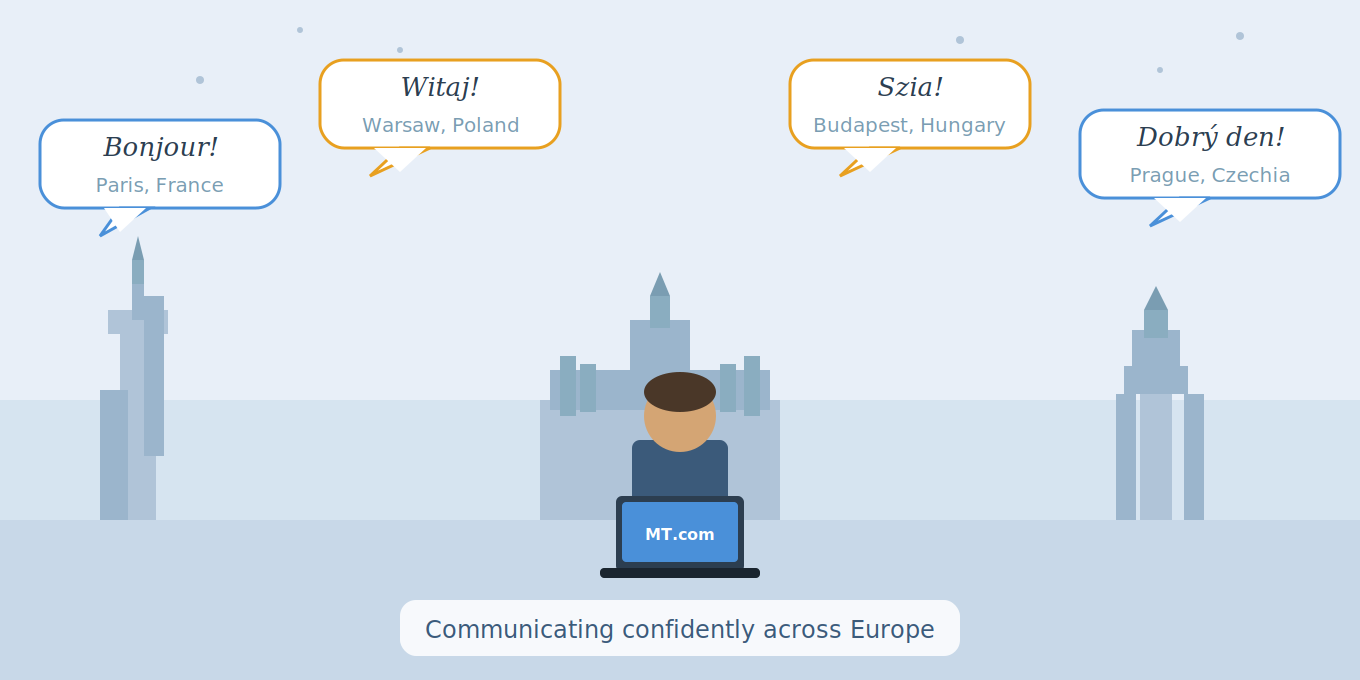
Learn five phrases in every market you enter. Greeting someone in their language, saying please and thank you correctly, and acknowledging that you do not speak the language fluently signals respect. It changes the dynamic of every interaction that follows.
Build a glossary for your domain. Legal, financial, and technical vocabulary is where AI translation makes its most consequential errors. Maintaining a domain-specific glossary and using it consistently dramatically improves accuracy across both AI and human translation.
What Are the Most Common Mistakes Professionals Make?
Trusting fluent output as accurate output. A grammatically correct translation is not necessarily a semantically correct one. Fluency is not the same as precision.
Using consumer tools for professional content. Google Translate is not designed for a shareholder letter or a supplier agreement. Match the tool to the stakes of the content.
Assuming English is sufficient. In many European markets, the decision-maker speaks English. The person who implements the agreement may not and that is where miscommunication causes real operational damage.
Skipping review. AI translation benefits from a native speaker review for anything published, sent to a client, or used in a legal context. Build this into the workflow rather than treating machine output as final.
Frequently Asked Questions
Can I rely on AI translation for business meetings?
For real-time support, AI translation works as a backup but not as a primary channel. For high-stakes meetings, hire a professional interpreter.
What is the most accurate AI translation tool available?
Accuracy varies by language pair and domain. Multi-engine platforms that aggregate outputs from multiple models tend to produce more consistent results across European language pairs than any single-engine tool.
Is machine translation good enough for marketing content?
For first drafts and internal content, yes. For published marketing materials, treat AI translation as a starting draft requiring human review and cultural adaptation not final copy.
What European languages are hardest for AI translation?
Languages with complex morphology, Finnish, Hungarian, Polish, Czech, remain significantly more difficult for AI translation than major Western European pairs like English-French or English-Spanish.
Conclusion
Language barriers in professional environments are not a soft problem. They affect contracts, relationships, and revenue, often without anyone identifying language as the cause.
The tools available today are better than they have ever been, and still not good enough to replace human judgment for high-stakes communication. The professionals who navigate this most effectively treat translation as a process: prepare materials early, match tools to content stakes, and build review into the workflow.
Confidence in non-English environments is not about speaking every language. It is about building a system reliable enough to protect the relationships that matter.