



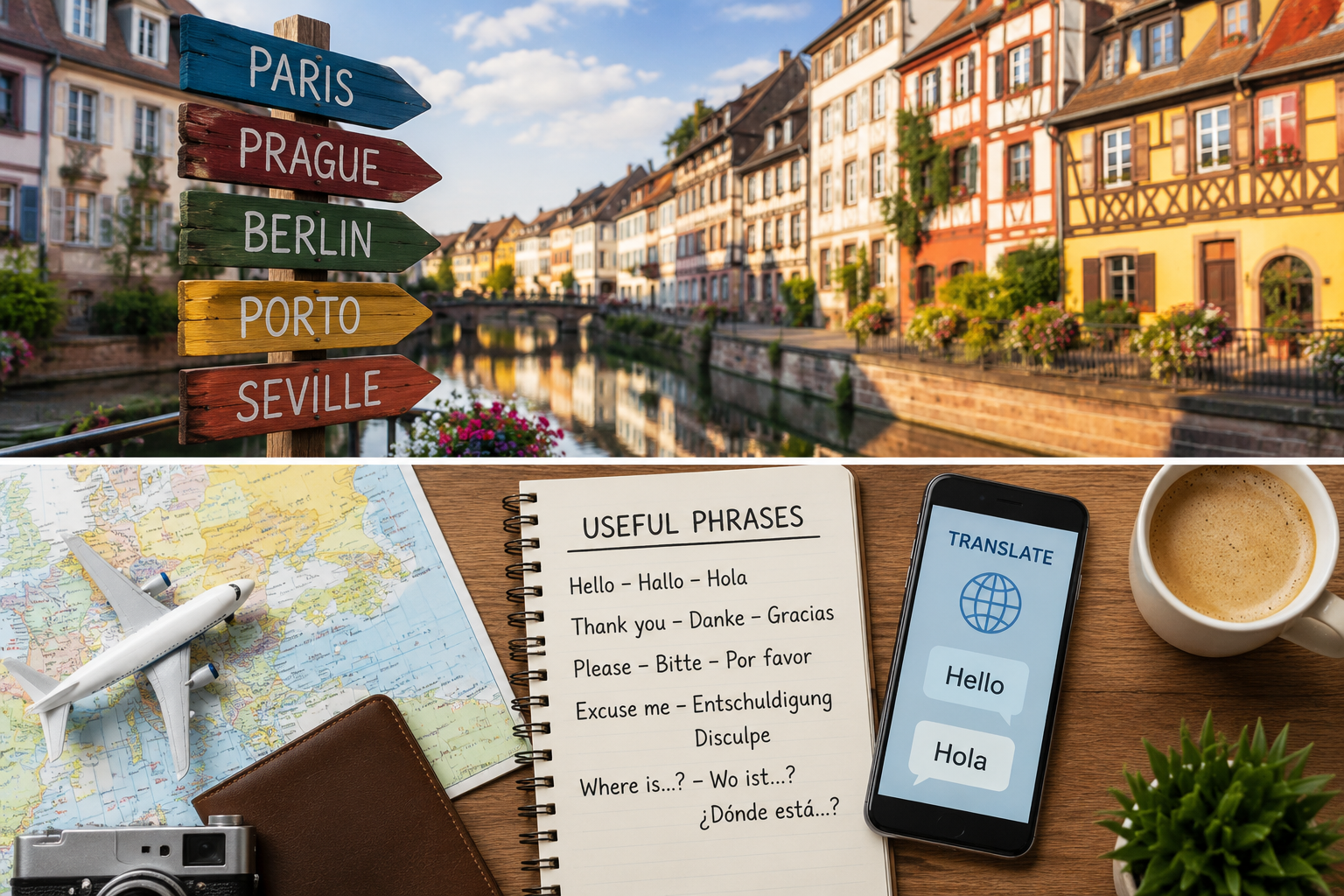
Europe has a reputation of being on of the easiest places in the whole world to travel to. Countries are linked by high-speed trains in hours, budget airlines on weekends make city breaks affordable and there are many places in the world where you will find English speakers who will make you feel at home.
However, there is one aspect of travelling in Europe that the guidebooks don’t focus on enough.
The things that make the most lasting memories are those that always occur beyond the tourist hot spots. Taking a lunch order at a family owned café, getting directions from a local in a quiet neighborhood, exchanging a few words with a vendor at a weekend market or learning the history behind a centuries-old monument. At these times, it is not always sufficient to use English.
Don’t be afraid to learn a little of the local language before you go, but if you are able to pick up a few phrases, or know how to communicate effectively, then you will experience your destination in a different way. You don’t just have to visit a location, you start to engage with it.
Here are some of the most rewarding places in Europe that will benefit you if you learn just a little bit of local language.
Why language shapes travel experience
Travel is not only about ticking off the check box of the landmarks. It’s about meeting people and learning about the culture, and how comfortable you are to venture outside of your comfort zone and what you are familiar to.
Although English is generally spoken in larger cities throughout Europe, it is not always the case in small town, traditional restaurants, markets or public transportation. If the locals are able to speak English, it is still a good idea to start a conversation with a salutary word or a thank-you in their native tongue.
There are a few phrases that you might know that can help you:
•Be more confident in navigating transportation.
• Interpret food labels and restaurant menus.
• Understand local customs.
•Create “real” dialogue with residents.
•Be more at ease to venture out and see less-touristy places.
This can lead to a more vibrant and interesting trip.
1. Berlin, Germany
With its rich history and contemporary flair, Berlin is one of Europe’s most intriguing cities.
Although many people in Berlin speak English, you will still find German on train platforms, in the museums, on the restaurant menus, in the neighborhood bakeries, etc. While you travel to smaller towns in Germany, you’ll find that local language skills are even more important.
Basic phrases such as Danke (thank you), Bitte (please/you’re welcome) and Entschuldigung (excuse me) are useful phrases.
While many people in the area speak English, it is best to try and learn a few words of German as it will create a more positive impression and demonstrate you respect the culture!
2. Seville, Spain
Seville is a city with a much different ambiance than Madrid or Barcelona. Narrow streets, flamenco performances, historic plazas and late-night dining will result in an unforgettable travel experience.
Even though tourism is strong, a high level of interaction is still done primarily in Spanish.
People working in restaurants, in the markets, taxi drivers, or owners of local shops may like it if you start speaking in Spanish and then switch to English if you need to.
These small gestures often contribute to better interactions and suggestions that aren’t found in travel guides. When you’re brushing up on common phrases before your trip, learning how do you say “you’re welcome” in Spanish is a good place to start, whether you’re thanking a waiter or chatting with someone at your hotel.
It’s also a good idea to learn a few key phrases ahead of time, such as those at MachineTranslation.com, for survival before you get to Spain. The AI translation tool features a comparison function for results of various AI models in 330 languages, which will assist a traveler in more natural expression of the words used in everyday communication.
3. Prague, Czech Republic
Prague is a very popular tourist destination, but many of the residents who live outside the tourist-heavy areas speak Czech as their native language.
Public transportation is efficient, but ticket machines, information at the stations and local events are not always in English.
Knowing some common words before you go will be helpful in common scenarios, like:
- Buying transportation tickets
- Czech cuisine – ordering traditional dishes on a Czech menu.
- Asking for directions
- Visiting neighborhood cafés
Even some of the simplest Czech is usually met with a friendly response from locals, who appreciate the effort.
4. Porto, Portugal
Although Lisbon has all the attention, especially on an international level, Porto boasts idyllic riverside streets, historical buildings, and one of Europe’s most famous food fests.
English is increasingly common among younger residents and businesses. Local bakeries, family-run restaurants and neighborhood stores, however, often have their services in Portuguese, with most of the products also being sold in the language.
Shopping at local markets is more enjoyable when you know some of the common phrases such as “good morning,” “thank you,” and “how much?
Don’t just use a translation app for all conversations; learn a few key words and phrases so that conversations feel more natural.
Looking Beyond Translation
Translation is more than the mere conversion from one language to another.
Context matters.
What can be an appropriate expression in one context can be too formal or even unfathomable in another. How language is used varies from region to region, country to country, and from one group to another, within the same area.
That’s why preparing for a trip isn’t about memorizing long vocabulary lists. It’s better to focus on phrases you’ll genuinely use. Even a small misunderstanding can turn into an awkward situation, which is part of why it’s worth reading up on common communication mistakes before you go.
Questions such as:
- Where is the train station?
- Can I pay by card?
- Thank you.
- Excuse me.
- Are you an English speaker?
- Often end up being more beneficial than long lists of words.
5. Kraków, Poland
The city of Kraków is a blend of medieval and modern architecture, with a rich culture. In addition to its Old Town, travelers will find many other independent cafes, local art districts and traditional Polish restaurants.
Menus are not necessarily translated, particularly in businesses that serve mostly local customers.
The most frequent food-related words can help you place your orders much easier, particularly if you’re not interested in foreign food, but regional cuisine.
Small phrases such as Dzień dobry (good day), Dziękuję (thank you) and Proszę (please/you’re welcome) are good ways of demonstrating respect for the local culture, and are likely to be welcomed by locals.
Language preparation can also be helpful at places like museums, or going to the train stations in the city.
6. Ljubljana, Slovenia
Though most often overshadowed by its more illustrious European cousins, Ljubljana continually delights visitors with its pedestrian-friendly city centre, cafes by the river and its relaxed vibe.
Although English proficiency is quite high, many public notices, community events and smaller businesses only communicate in Slovenian.
By knowing these simple food words, numbers, and the polite phrases, you’ll find it easier to buy things at local markets.
When visiting the surrounding villages or having the opportunity to visit a national park, language preparation is even more appreciated.
While technology has its benefits, preparation is still more important.
The role of multilingual travel has become much easier than it was even a couple of years ago thanks to modern tools of AI.
Multiple translations, or a comparison of several different translations, can be more confident than a single translation, particularly when reading restaurant menus, traveling or communicating in everyday situations.
A problem with the use of AI translation is that various models can translate the same sentence in various ways. This is particularly the case for idioms, everyday expressions or culturally-specific responses (where context is as important as the words). Instead of just one translation, the visitors of MachineTranslation.com can compare side by side different translations of the same text found in various AI models, to grasp the nuances of interpretation and select a translation that seems more natural to them before they use it in actual conversations.
Nevertheless, in the case of technology, a modicum of preparation is required to work out the best of both worlds.
Before going abroad, it’s important to consider some useful expressions, practise basic pronunciation and familiarise yourself with local etiquette to avoid problems in the first place.
Technology is not intended to take the place of people, but to augment them.
Before your European trip, use the following tips to help you:
First learn the basics then build on them.
Focus on the first set of words: greetings, directions, numbers, transportation words and restaurant phrases.
Practice pronunciation
It doesn’t matter if they don’t get the pronunciation right, it’s still respect and sometimes it spurs them on to assist.
Store useful phrases (on the local device)
It is not always possible to get an internet connection at train stations, underground train and in rural areas.
Understand local customs
Certain expressions vary in meaning from country to country and/or context to context. It’s equally important to understand when and how they are used as well as knowing their translation.
Avoid posturing, don’t fear to try
Most Europeans will not expect your guests to speak the language perfectly in German, Spanish, Portuguese, Czech or Polish.
If you make an attempt, it’s typically recognized and is usually the starting point in a wonderful conversation.
The Better the Souvenir, the Connection You Make”
There are more than just castles, museums or well-known landmarks in Europe.
They are the discussions with a local that you would hear about the best local café. Surprise appearance at the community festival.. The smile upon trying to say hello or anything else in the person’s native tongue.
These moments are very rare, as it’s hardly likely they would have happened if you spoke well.
They occur because you attempted!
If you’re about to embark on your next trip to Europe, take some time to learn the language you will be most likely to come across. Some carefully selected words and a good knowledge of how to use them can open up the door that no travel itinerary can.